Showing posts with label Civil War. Show all posts

Wednesday, September 17, 2025

Book Review: Queen of Cotton (Texas Brave & Strong, #2) by Laurie Moore-Moore

Queen of Cotton: Confederate Camel Caravan (Texas Brave and Strong Book 2)Queen of Cotton: Confederate Camel Caravan by Laurie Moore-Moore
My rating: 5 of 5 stars

Exciting, entertaining, and educational!

The Queen of Cotton is the second book in author Laurie Moore-Moore’s Texas Brave and Strong series, continuing the historical fiction story of Sara Darnell Brown. This new novel is about Sara’s camel cotton convoy that travels across the state of Texas to get their product to foreign markets at the start of the American Civil War, when the traditional routes were blockaded. This surprising tale is one of overcoming obstacles and hardships, exciting yet terrifying Indian and bandit encounters, rich in historical detail, and full of heart and emotion.

Sara Brown must once again draw deeply on everything she’s got to get Dallas’s cotton farmers’ crops to market on her own when her husband, Benjamin, joins the Texas Frontier Rangers in protecting the state’s borders. The careful plans he’d made and shared with Sara before mobilizing to the frontier fell through as the men needed to make it work, also left for war. Sara, already fully occupied with getting her mercantile back up and running after the devastating fire in Dallas the previous year, is somewhat familiar with his business and is able to come up with an unusual alternative using camels left over from earlier experiments with their use on the Texas frontier. Although I was aware of the traditional views men held at that time about women’s roles, I was still surprised by some of the characters’ vehement reactions to Sara taking charge. On the other hand, I liked Jonah Watson’s characterization as a large, strong, and capable foreman with an unheard-of classical education. Viewed as a member of the Watson family, he was still enslaved.

The plot is well-paced, with interesting historical tidbits sprinkled throughout the story, and I loved the appearances by actual historical figures. My emotions were immediately engaged by the leave-takings of the husbands, fiancés, fathers, and sons as they headed to fight for the Confederacy or serve with the Rangers. Many of the women had experienced this same type of separation years before, either during Texas’s fight for independence from Mexico or the Mexican-American War, not knowing if they’d see their loved ones alive ever again. However, they were not given much time to think about it, as their lives and those of their families depended on their continued efforts to move forward.

I recommend THE QUEEN OF COTTON to readers of historical fiction, especially those who enjoy a story set during the Civil War or on the Texas frontier.

I voluntarily reviewed this after receiving an Advance Review Copy from the author through Lone Star Literary Life Book Campaigns.


View all my reviews

Saturday, July 05, 2025

Book Review -Too Much the Lion: A Novel of the Battle of Franklin by Preston Lewis

Too Much the Lion: A Novel of the Battle of FranklinToo Much the Lion: A Novel of the Battle of Franklin by Preston Lewis
My rating: 5 of 5 stars

The life and times, as well as the horrors and realities of the Civil War, are encapsulated in this fictional account of the Battle of Franklin, Tennessee.

Too Much the Lion by Preston Lewis is a compelling historical novel of the days leading up to, the results, and aftermath of this tragic battle during the closing days of the American Civil War at Franklin, Tennessee. A battle that shouldn’t have been fought; it cemented the Confederate loss and changed the course of life for thousands.

The novel presents the stories of generals, soldiers, and the residents of the area as they prepare for the fateful clash between an exhausted and undersized Confederate army against an entrenched Union force many times its size. Lewis gives readers an insider’s view into every angle of the tragic events, and it is an emotional and draining vision, with all the inevitability of watching a train wreck unfold. What sets this recounting apart from others of its kind is the portrayal of the participants; the author brings these people to life.

I recommend TOO MUCH THE LION to readers of historical fiction and Civil War stories.

I voluntarily reviewed this after receiving an Advance Review Copy from the author through Lone Star Literary Life Book Campaigns.


View all my reviews

Sunday, June 22, 2025

Book Campaign & Giveaway - Too Much the Lion: A Novel of the Battle of Franklin by Preston Lewis


TOO MUCH THE LION

A Novel of the Battle of Franklin

by

PRESTON LEWIS


Historical Fiction / Civil War Fiction
Publisher: Bariso Press
Pages: 395
Publication Date: May 13, 2025


SYNOPSIS

In the waning months of the American Civil War, a delusional Confederate commander makes a desperate attempt to change the course of the South’s dwindling hopes by invading middle Tennessee. The tragic result of Lt. Gen. John Bell Hood’s misplaced hubris devastates his Army of Tennessee and alters the lives of the citizens of Franklin, Tennessee.

In a historical novel reminiscent of The Killer Angels, Too Much the Lion follows a handful of Confederate generals, infantrymen and local residents through the five days leading up to the horrific Battle of Franklin on November 30, 1864. The lives of soldiers ranging from Major General Patrick Cleburne to Brigadier General Hiram Granbury and from Sergeant Major Sumner Cunningham and to Corporal Sam Watkins will be forever changed by Hood’s decisions and mistakes.

Franklin civilians like apprehensive and loving mother Mary Alice McPhail and teen Hardin Figuers, desperate to serve the Confederacy but too young to enlist, are ensnared in the events that will bring death and devastation to their very doorsteps. Devout Confederate Chaplain Charles T. Quintard must reconcile his religious beliefs with his support of slavery. Slaves like the elder Wiley Howard and the inquisitive young Henry B. Free are trapped on the fault line between what has been and what could be.

Too Much the Lion offers an unvarnished account of the dying days of the Confederacy in a powerful and moving narrative of honor and betrayal, bravery and cowardice, death and survival. Told with poignancy and honesty by an accomplished novelist, Too Much the Lion achieves for the Battle of Franklin what The Killer Angels did for the Battle of Gettysburg, providing a classic fictional account of one of the Civil War’s pivotal encounters.

CLICK TO PURCHASE


ABOUT THE AUTHOR

Preston Lewis is the award-winning author of some sixty western, historical, juvenile, and nonfiction works.  In 2025 he was honored with the Will Rogers Medallion Awards’ Lifetime Achievement Award for his contributions to the literature of the American West.  The Texas Institute of Letters in 2021 elected him to membership for his literary achievements. 

Western Writers of America (WWA) has honored Lewis with three Spur Awards, one for best article, the second for best western novel and the third in 2025 for juvenile nonfiction.  He has received ten Will Rogers Medallion Awards—six gold, two silver and two bronze—for written western humor, short stories, short nonfiction, and traditional Western novel.

Lewis is a past president of WWA and the West Texas Historical Association, which named him a fellow in 2016.  He holds a bachelor’s degree from Baylor University and a master’s degree from Ohio State University, both in journalism.  Additionally, he has a second master’s degree in history from Angelo State University.

He lives in San Angelo, Texas, with wife Harriet Kocher Lewis. 


To learn more about the book, look for #LSLLTooMuchTheLion on your preferred social media platform.


FOR DIRECT LINKS TO EACH REVIEWER PARTICIPATING


Monday, May 05, 2025

Teaser: Too Much the Lion by Preston Lewis


Too Much the Lion
A Novel of the Battle of Franklin
by
Preston Lewis


US Historical Fiction / Civil War
Publisher: Bariso Press
Publication Date: May 13, 2025
Page count: 395 pages


SYNOPSIS:
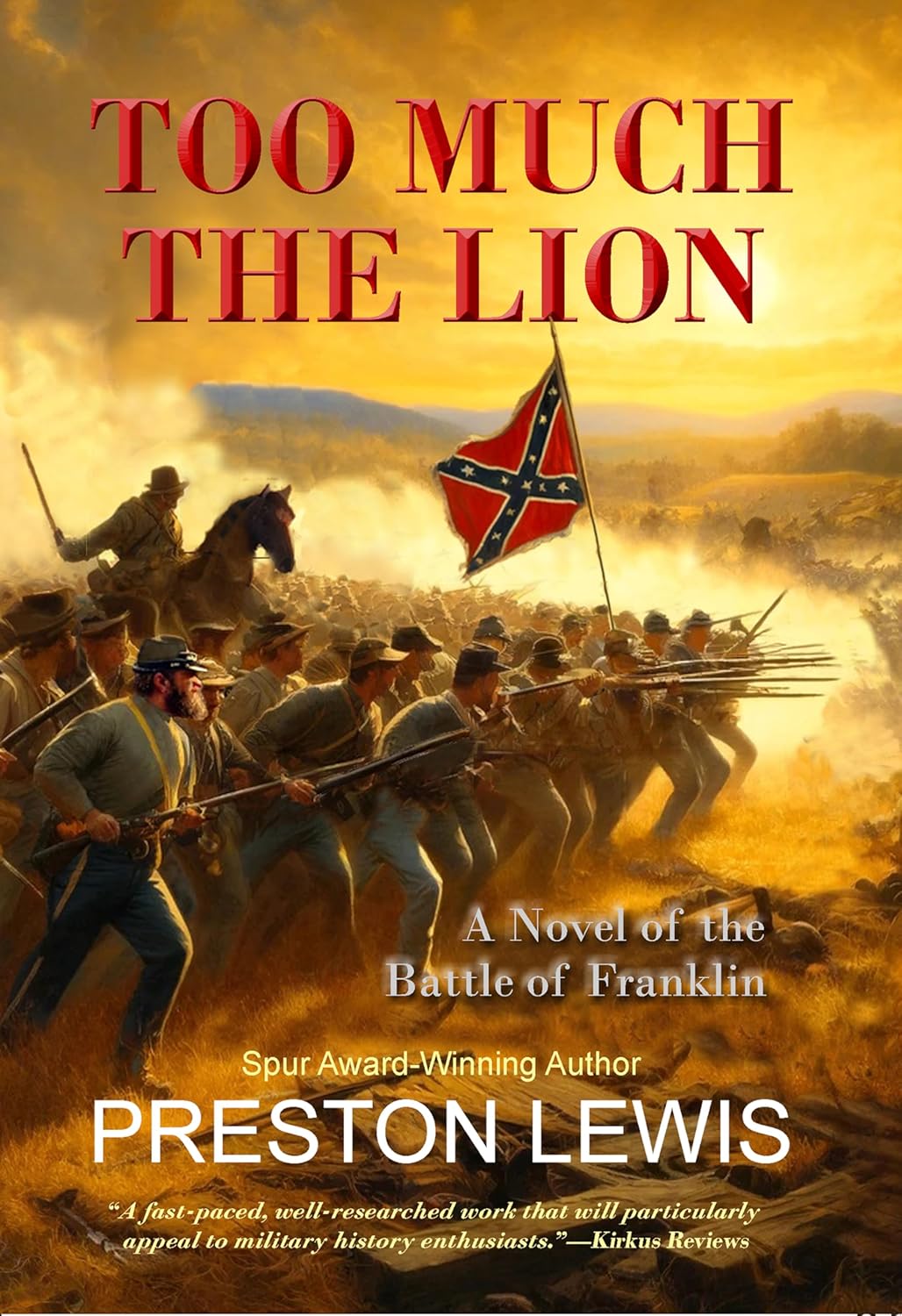
The soldiers did the fighting; the generals, the Infighting

In the waning months of the American Civil War, a delusional Confederate commander makes a desperate attempt to change the course of the South’s dwindling hopes by invading middle Tennessee. The tragic result of Lt. Gen. John Bell Hood’s misplaced hubris devastates his Army of Tennessee and alters the lives of the citizens of Franklin, Tennessee.

In a historical novel reminiscent of The Killer Angels, Too Much the Lion follows a handful of Confederate generals, infantrymen and local residents through the five days leading up to the horrific Battle of Franklin on November 30, 1864. The lives of soldiers ranging from Major General Patrick Cleburne to Brigadier General Hiram Granbury and from Sergeant Major Sumner Cunningham to Corporal Sam Watkins will be forever changed by Hood’s decisions and mistakes.

Franklin civilians like apprehensive and loving mother Mary Alice McPhail and teen Hardin Figuers, desperate to serve the Confederacy but too young to enlist, are ensnared in the events that will bring death and devastation to their very doorsteps. Devout Confederate Chaplain Charles T. Quintard must reconcile his religious beliefs with his support of slavery. Slaves like the elder Wiley Howard and the inquisitive young Henry B. Free are trapped on the fault line between what has been and what could be.

Too Much the Lion offers an unvarnished account of the dying days of the Confederacy in a powerful and moving narrative of honor and betrayal, bravery and cowardice, death and survival. Told with poignancy and honesty by an accomplished novelist, Too Much the Lion achieves for the Battle of Franklin what The Killer Angels did for the Battle of Gettysburg, providing a classic fictional account of one of the Civil War’s pivotal encounters.

CLICK TO PURCHASE!


Foreword


Too Much the Lion is the story of the Battle of Franklin and the five days leading up to the disastrous conflict as lived by select generals, infantrymen, and civilians in the waning weeks of the Confederacy. In a war filled with tragic encounters, this was one of the most heartrending, yet least remembered battles of the Civil War, largely because it occurred in the Western Theater, far removed from the aura of Robert E. Lee and the Army of Northern Virginia.

The Confederate Army of Tennessee produced no Robert E. Lee, but instead fought under a succession of mediocre commanders whose battlefield triumphs were limited to a single decisive but bloody victory at Chickamauga. The army’s commanders had little else to show for the sacrifice of Rebel men and boys. Though the overall leadership lacked the tactical flair of a Lee or a Stonewall Jackson, the Army of Tennessee possessed some superb generals such as cavalryman Nathan Bedford Forrest and division commander Patrick Ronayne Cleburne, who both appear in this account, though the focus is on the lesser-known Cleburne and his division.

With more than 8,500 combined casualties, the Battle of Franklin does not make the top twenty list of Civil War battles with the most losses. Even so, Union and Confederate forces endured five of the most ferocious hours of combat during the War Between the States. Besides the hubris of Army of Tennessee commander John Bell Hood, the events of the preceding night at Spring Hill contributed to the next day’s ill-fated attack—dubbed “the Pickett’s Charge of the West”—at Franklin.

In one of the greatest blunders of the Civil War, the Union army slipped past the Army of Tennessee during the night at Spring Hill, Tennessee, and escaped the trap Lieutenant General Hood had set but failed to execute. Charges and countercharges about who was at fault echoed through the years, and historians remain conflicted about who forfeited one of the South’s last opportunities for a victory over Union forces. The interpretations of the events at Spring Hill in Too Much the Lion are entirely those of the author after considerable research and head-scratching.

In addition to the many generals mentioned in this historical novel, two Confederate infantrymen who left accounts for posterity provide perspective from the viewpoint of the foot soldier. While novels about war rightfully focus on soldiers, battle takes its toll on civilians as well, so two Franklin families—the Carters and the Figuers—provide perceptions beyond those of the troops. Two slaves serving Confederate officers as manservants—one elderly and one in his teens—also enter the narrative.

Except for two characters, all the names listed are those taken from historical accounts. The name of a Franklin doctor was fictionalized, and the last name of the slave named “Henry” was added since the historical account only listed his first name. Otherwise, the names are actual, including the lists of casualties and the causes of their deaths. The interpretation of each character is that of the author, based on his research.

Too Much the Lion is told entirely from the Confederate viewpoint, both soldier and civilian. It is important to remember that by late 1864, both Southern combatants and noncombatants had endured three years of death and deprivation. Both citizens and warriors alike were tired of war, its hardships, and the uncertainty it created for their futures.

For those unfamiliar with the organization of a Confederate army, the Army of Tennessee operated under Lieutenant General John Bell Hood in overall command of three infantry corps and a cavalry corps under the direction of Major General Nathan Bedford Forrest. This account focuses on the corps under the command of Major General Benjamin Franklin Cheatham of Tennessee. His three division commanders included Major General Patrick Ronayne Cleburne of Arkansas and Major General John C. Brown of Tennessee, who are pivotal in this account. Major General William B. Bate of Tennessee also served as a division commander under Cheatham, but he played a lesser role in the events as depicted in Too Much the Lion.

Three brigades under the commands of brigadier generals Hiram B. Granbury of Texas, Daniel C. Govan of Arkansas, and Mark P. Lowery of Mississippi reported to Cleburne, their division commander. Between seven and ten regiments designated by number and state served under these three brigadier generals.

Two of the four brigades in Brown’s division appear in this account. Commanders of those brigades were brigadier generals States Rights Gist of South Carolina and Otho F. Strahl of Ohio. While other generals and combatants show up in this account, their roles are nominal in this telling of the story of the Battle of Franklin.

In compiling this narrative, the author has attempted to stay within the historical framework of the events leading up to and culminating in the Battle of Franklin and its aftermath. Occasionally, time elements may have been compressed or slightly altered for the sake of the overlapping narratives from the different viewpoints.

If nothing else, perhaps Too Much the Lion will drive readers to the historical accounts of the Battle of Franklin to make their own assessments and draw their own conclusions of the tragic encounter in the waning months of the Civil War. If Too Much the Lion accomplishes anything, perhaps it will give Patrick Ronayne Cleburne his due as one of the noble generals of the Civil War, much like The Killer Angels elevated Joshua Lawrence Chamberlain into the public consciousness.

Too Much the Lion is a novel of war, and war is the failure of man to live up to the “better angels of our nature” as President Abraham Lincoln first used the term in his 1861 inaugural address before the start of the conflict that killed more Americans than any other in our nation’s history.

By its very nature, however, any novel of war is also an anti-war novel, for it shows the dire consequences on individuals of political and military deceit and hubris. Perhaps Too Much the Lion offers lessons for today if we are honest and humble enough to accept them.


ABOUT THE AUTHOR:

Preston Lewis is the award-winning author of more than 50 western, historical, juvenile, and nonfiction works.  In 2021 he was inducted into the Texas Institute of Letters for his literary achievements.

Western Writers of America (WWA) has honored Lewis with two Spur Awards, one for best article and the second for best western novel.  He has received ten Will Rogers Medallion Awards (six gold, two silver and two bronze) for written western humor, short stories, short nonfiction, and traditional Western novel.

Lewis is a past president of WWA and the West Texas Historical Association, which named him a fellow in 2016.  He holds a bachelor’s degree from Baylor University and a master’s degree from Ohio State University, both in journalism.  Additionally, he has a second master’s degree in history from Angelo State University.  He lives in San Angelo, Texas, with wife Harriet Kocher Lewis.

| Website | Blog | Facebook | Goodreads |


RABT Book Tours & PR

Sunday, November 24, 2024

Book Review: The Best General in the Civil War by Conrad Bibens

The Best General in the Civil WarThe Best General in the Civil War by Conrad Bibens
My rating: 5 of 5 stars

Fictionalized yet riveting story of the life of General George Thomas and his service to the Union during its most critical times.

The Best General in the Civil War by Conrad Bibens is the fictionalized yet riveting story of the life of General George Thomas and his critical contributions in service to the country before, during, and immediately after the Civil War. The author has General Thomas tell his own tale from childhood to post-Civil War using the device of an imaginary writing of a memoir, as dictated to his wife, Frances Kellogg Thomas, in response to an inflammatory newspaper article five years after the end of the war. In truth, Thomas destroyed his personal papers prior to his death.

While the name of George Thomas has been overshadowed by that of Ulysses Grant and William Sherman, many historical observers and scholars of the war paint Thomas as the true reason for many of the Union’s critical victories. Readers are presented with the facts from Thomas’s perspective about his experiences during the war. His words are those of a proud and confident storyteller, giving voice to his successes and disappointments, many of which came at the hands of supposed friends and representatives of the government of which he served. I came away with a very different view of what this war was like, with details of dismissed strategies and missed opportunities, miscommunications, ineffective leadership, and poor decisions on both sides of the conflict. Battles are tense and exciting and described with a clear choreography that even I, unskilled and uneducated in such, could follow and envision.

The story is as exciting as any adventure tale, often evoking emotional responses to events long past, especially when discussing the gut-wrenching decisions our ancestors made to stay with the United States or secede. The tale brought to life the fact that these fighting men had all been classmates or had served together previously before facing each other from opposite sides. It is often pointed out that families were split apart, with brothers fighting brothers, but usually, this is intoned in very general terms. This book names names, families where this actually occurred, making this tragedy personal and all the more heartbreaking. I didn’t know that President Lincoln himself had a brother-in-law who sided with the Confederates and was killed in action fighting against Union troops. Thomas was separated from all but one of his brothers for the rest of his life and vilified by the people of his home state of Virginia for staying true to his military oath.

I recommend THE BEST GENERAL IN THE CIVIL WAR to readers of historical fiction, especially those interested in the Civil War.

I voluntarily reviewed this after receiving an Advanced Review Copy from the author through Lone Star Book Blog Tours.

Content Warning: slavery, war, death, Ku Klux Klan


View all my reviews