Thursday, November 26, 2026

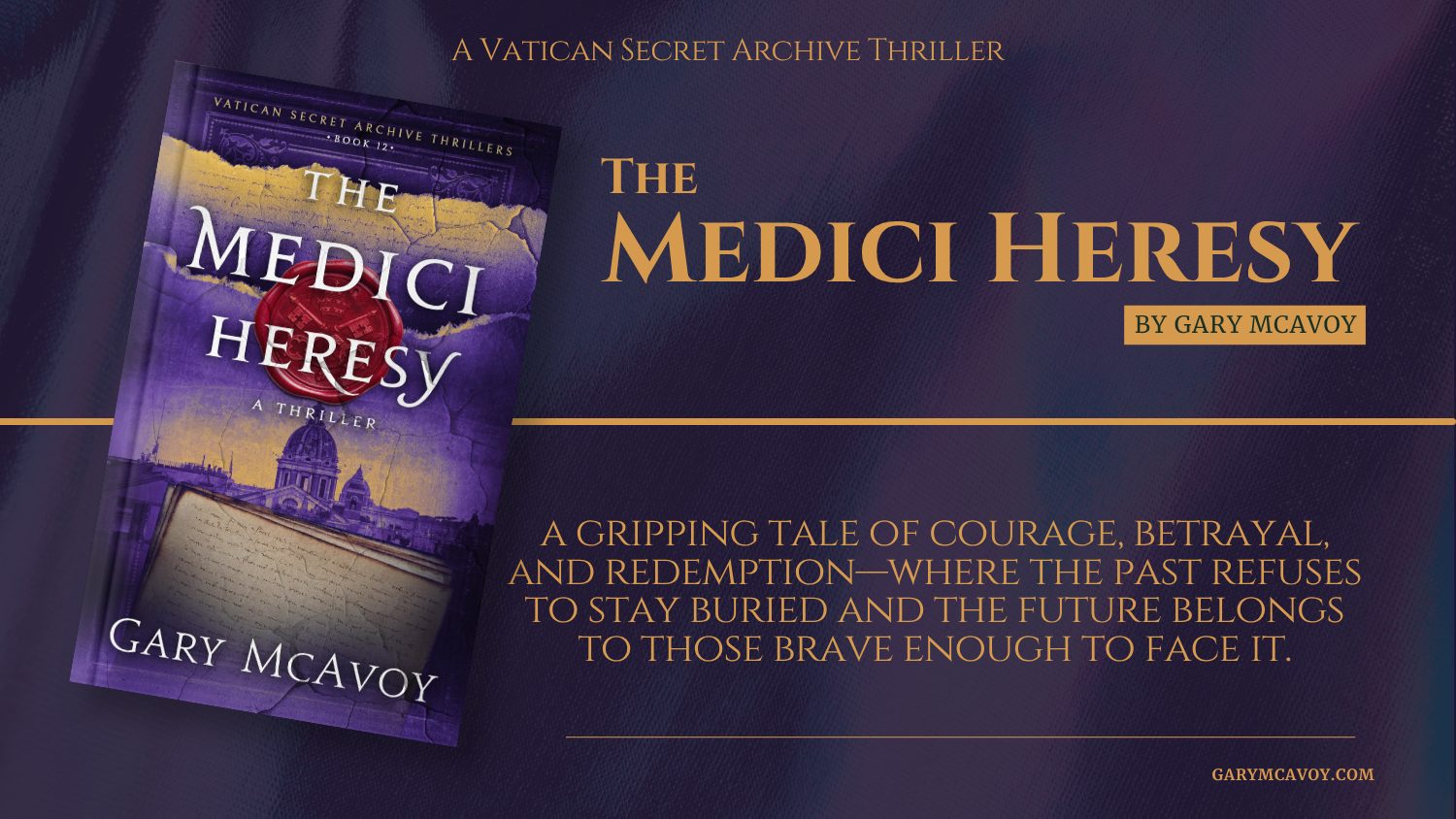
Virtual Book Tour & Giveaway: The Medici Heresy (Vatican Secret Archive Thriller, #12) by Gary McAvoy

The Medici Heresy by Gary McAvoy Banner

THE MEDICI HERESY

by Gary McAvoy

November 2 - 27, 2026 Virtual Book Tour

Synopsis:
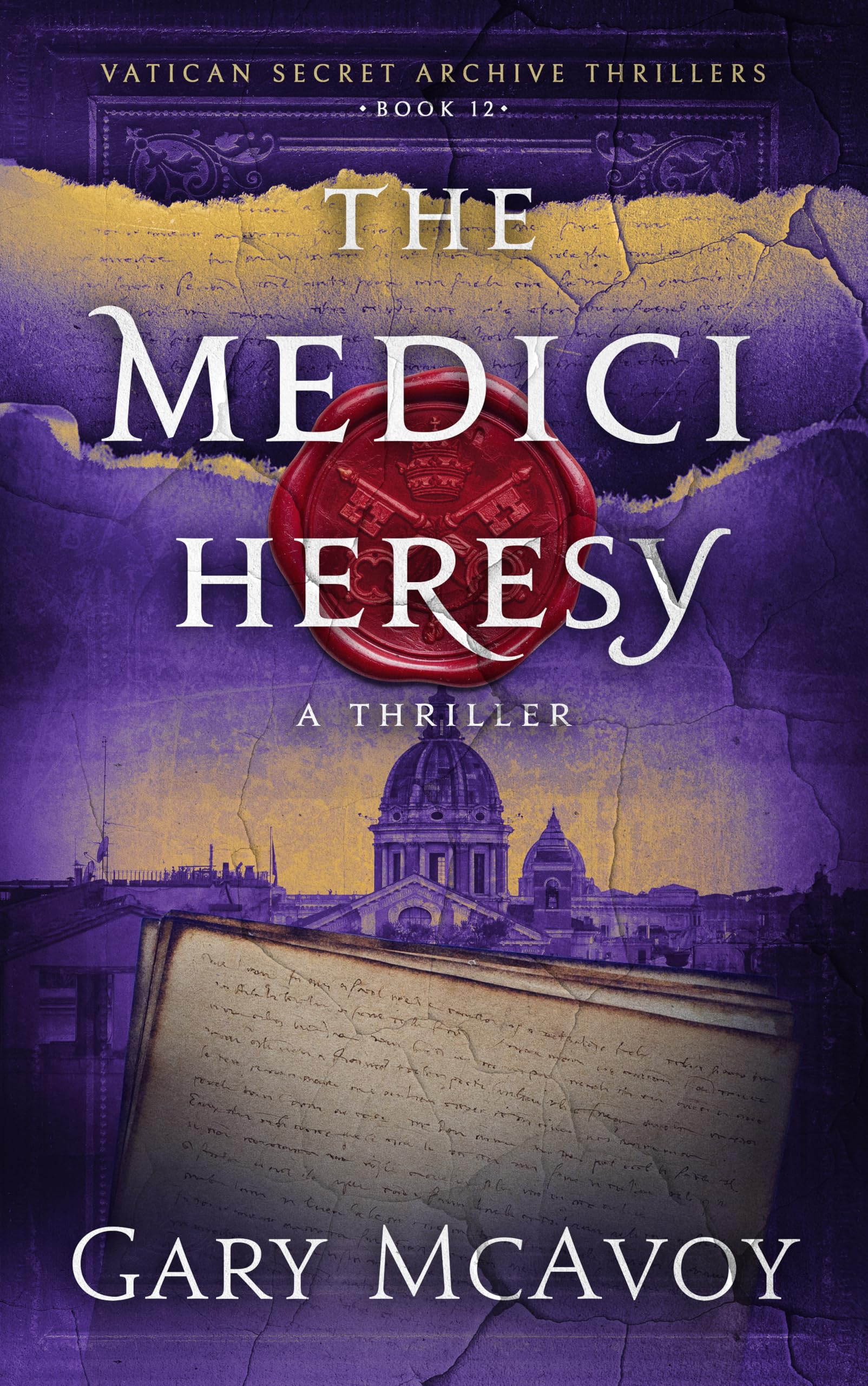
The Medici Heresy by Gary McAvoy

A Vatican Secret Archive Thriller

When Father Michael Dominic uncovers a sealed Renaissance letter hidden deep within the Vatican Archives, he awakens a five-hundred-year-old secret buried by Pope Clement VII at the height of the Medici dynasty. Joined by investigative journalist Hana Sinclair, Michael follows a trail of clues through forgotten chapels, papal confessions, and ancient astronomical alignments, each step drawing them deeper into a mystery the Church once swore to silence. What begins as a scholarly puzzle quickly becomes a struggle for survival as shadowed forces—both inside and outside the Vatican—move to control or destroy what Clement left behind.

Their search reveals two extraordinary manuscripts: the Gospel of the Beloved, attributed to Mary Magdalene, and the Codex of Voices, a Renaissance record documenting the Church’s attempt to bury it forever. As Michael, Hana, and their Swiss Guard allies navigate the danger closing in around them, they confront a truth that challenges not doctrine but conscience: why some voices endure across centuries while others are violently erased. With each revelation, the line between faith and fear grows thinner, and the cost of honesty becomes terrifyingly clear.

Rich in historical detail and steeped in Vatican intrigue, The Medici Heresy weaves a modern thriller through one of the Church’s darkest chapters. From Medici Florence to the underground chambers beneath St. Peter’s Basilica, Gary McAvoy delivers a gripping tale of courage, betrayal, and redemption—where the past refuses to stay buried and the future belongs to those brave enough to face it.

While part of the Vatican Secret Archive Thrillers series, The Medici Heresy is a standalone adventure that can be enjoyed by new readers and longtime fans alike.

Praise for The Medici Heresy:

"A guilty pleasure! I’ve read all of these books in the series and love anything about Mary Magdalene. The rain became an oppressive character and seems like would have prevented them seeing the light coming through the aperture to find the hidden compartment of the sixth or so letter. I appreciate that the author distinguishes fact and fiction at the end of the book and hope he does not run out of archives to chase down."
~ Karin

"Bravo.....again!!! You keep me captivated! I look forward to the next story in the archival series. I adore every one of your characters, good and bad. Please keep writing."
~ Karen Veltman

"Great read! Gary McAvoy’s novels are all exciting and filled with historical references …but I truly enjoyed this novel the most—he has a way of painting pictures with words."
~ Amazon Customer

The Medici Heresy Trailer:

Book Details:

Genre: Vatican Historical Thrillers
Published by: Literati Editions
Publication Date: November 25, 2025 | HC
Number of Pages: 394 | HC
ISBN: 9781954123786 (ISBN10: 1954123787)
Series: A Vatican Secret Archive Thriller, Book 12 || Stand Alone
Book Links: Amazon | Kindle | Barnes & Noble | BookShop.org | Goodreads | BookBub | Gary McAvoy Books

Read an excerpt:

Vatican City, Present Day

Father Michael Dominic cherished mornings the way a monastic scribe once revered a well-cut quill: not as luxury, but as necessity. In the hushed corridors beneath the Apostolic Palace, where the sunlight filtered weakly through narrow glass slits and history exhaled dust from every shelf, he found peace in routine.

Each morning began before the bells. Rising at five, he slipped into the worn cassock that had traveled with him from his Jesuit seminary days, now threadbare at the cuffs but softened with memory.

But for his pre-dawn run, the cassock stayed folded on its hook. Michael preferred the quiet streets before sunrise—the echo of his footsteps on cobblestone, the scent of baking bread drifting from Trastevere, the soft hum of Rome preparing to wake. When he circled back toward the Borgo, sweat cooling on his skin, he made his customary stop at Pergamino Caffè just outside the colonnade.

Signora Palazzolo, who had run the tiny shop since her husband’s passing, spotted him through the window before he reached the door. She bustled out from behind the counter with a small bundle wrapped in brown paper. “Padre Dominic,” she said, wagging a finger at the sight of his running clothes, “the Holy Father may tolerate many things, but not a priest entering the Vatican dressed like a marathoner.”

Michael smiled. “You spoil me, Signora. You know that, don’t you?”

“I preserve your dignity,” she corrected, pressing the parcel into his hands. Inside was a freshly laundered cassock—one of two she kept for him, neatly sewn and ironed, refusing payment beyond a whispered blessing. “The restroom is free. Go, go. Before the guard at Sant’Anna thinks you’ve lost your vocation.”

He thanked her, ducked into the small restroom at the back, and splashed cool water on his face until the last traces of sweat faded. He unwrapped the cassock, slipping into the familiar black fabric and fastening the collar with practiced ease. The transformation was always the same: from runner to priest, from solitude to service.

When he stepped back into the café, Signora Palazzolo handed him a steaming paper cup. “For the road,” she said. “And tell the Swiss Guard I said buongiorno.”

Michael grinned, lifted the coffee in a small salute, and stepped into the crisp morning air. The Porta Sant’Anna gate waited a short walk away, its stone arch flanked by the bright uniforms of the Swiss Guard—his threshold to a world of parchment, secrets, and the quiet weight of history waiting to be unsealed.

Father Michael Dominic did not resemble the image most people carried of a Vatican archivist. Tall and athletically toned, with long black hair often tied back and deep brown eyes that missed little, he moved with the quiet confidence of someone accustomed to slipping between worlds—faith and doubt, past and present, obedience and inquiry. Raised in Queens by his devout mother, the housekeeper of the parish rectory, Michael had spent his childhood in the company of priests, altar candles, and shelves of worn theological books. It was Father Enrico Petrini, the parish’s pastor and the closest thing Michael had ever known to a father, who nurtured his restless curiosity and encouraged him toward the priesthood long before Michael understood what such a calling would demand.

He went on to study paleography at the Pontifical Institute at the University of Toronto and theology at the Gregorian University, credentials that earned him a coveted post in the Vatican Apostolic Archives. But what truly distinguished him was not his scholarship—it was his temperament. Michael approached hidden truths with the humility of a believer and the relentlessness of an investigator, guided by a conscience that refused to ignore what others preferred to bury. He possessed an almost unsettling ability to sense when history had been bent or softened for convenience, and he had learned that the Church’s oldest secrets rarely slept quietly. In Rome, that made him invaluable—and, at times, dangerous to those who feared what he might uncover next.

His key—a heavy, iron-forged piece given only to him as Prefect and to two deputies—turned with a low click in the Archives’ bronze door. The great subterranean labyrinth beyond stirred only with the hum of climate controls and the occasional scurry of mice that had somehow defied Swiss Guard extermination efforts for generations.

He always entered alone.

Descending the spiral stone staircase into the belly of the Vatican, Michael would pause briefly before the marble sculpture of St. Lawrence, patron saint of archivists. The statue stood solemn watch in the vestibule, his martyr’s gridiron beside him, eyes uplifted as if still seeking light in the depths. Michael touched the cool marble of its base, murmuring a quiet invocation in Latin: “Custos silentii, ora pro nobis”—Guardian of silence, pray for us.

Then began the work.

Today had begun like any other. He had donned his archivist gloves, retrieved his logbook, and walked the long central corridor toward the restricted manuscript chamber. The hum of dehumidifiers formed a familiar backdrop to his thoughts. A new cataloging project awaited—three fifteenth-century codices donated by the Archdiocese of Seville, each wrapped in cloth and tagged in Vatican gray. He had been preparing a report for the Cardinal Librarian on the authenticity of their bindings. Nothing about the day had suggested interruption.

But at precisely 9:43 a.m., as the daily delivery from the Vatican Post Office arrived via pneumatic tube—a sleek, hissing canister that thudded gently into the brass receptacle near his desk—his day unraveled.

The canister clunked against the metal lip with more force than usual.

Michael turned with mild curiosity. Inside was the usual: interdepartmental memos, two periodicals, and a sealed envelope marked Bibliotheca Apostolica Vaticana. But below them was something he didn’t recognize: a flat parcel wrapped in vellum, the edges tied neatly with deep burgundy ribbon. It bore no address, only his name—P. Michael Dominic—written in looping script that instantly evoked another age.

He stared at it for a long moment before touching it.

The handwriting was unlike any he had seen in modern routine Vatican correspondence. Ornate, yet disciplined. The capital “P” had a serpentine curl; the “M” was double-looped in the style of Renaissance scribes. Someone had gone to great lengths to mimic or preserve an earlier penmanship, complete with sepia-toned ink. There was no seal, no watermark, no sender’s mark on the reverse. Just a small, embossed Medici crest faintly pressed into the parchment—a shield bearing six spheres and a lily crown.

His pulse stirred.

He turned the envelope in gloved hands. The sender had access to the Vatican’s internal postal network. That narrowed the list considerably—and dangerously. Only a handful of people were authorized to send mail directly to the Secret Archives via internal courier. Which meant one of two things: either a trusted insider had left him a relic—or someone had breached the Vatican’s most secure internal system with cunning precision.

Either way, it would require discretion.

Michael slipped the package into his document satchel and continued his day as if nothing had happened. But the weight of the thing—though barely a few ounces—gnawed at the back of his thoughts like a thread working loose in a tapestry.

Later, after lunch in the Sala Clementina with two fellow scholars, he retreated to his personal workroom. It was a modest chamber tucked off the northeast passage—just large enough for a desk, three chairs, and a carved wood icon of St. Jerome, patron saint of librarians and biblical scholars, in his study—a fitting presence in a place where symbology saturates every hallway, painting, and page, speaking in codes as ancient as the Church itself. The room smelled of old oak, wax polish, and aging paper.

He shut the door, drew the curtains, and sat.

With deliberate calm, Michael untied the ribbon.

Inside was a folded letter on parchment that had yellowed with age but remained pliant, as if it had been lovingly preserved. No brittle edges, no flaking. The ink had faded in parts, but the script remained legible—calligraphic Latin in a bold humanist hand. The opening line read:

Ad futurum pontificem, qui veritatem non timebit… “To the future pontiff who shall not fear the truth…”

Michael leaned forward, his breath shallow.

The salutation alone stirred unease. Not merely because of its boldness—but because of the signature. Faint, in the lower corner, faded but unmistakable:

Clemens VII, Pontifex Maximus

For several long moments, he stared at the name.

Clement VII—Giulio de’ Medici—was one of the most politically embattled popes in Church history. His papacy had spanned the brutal Sack of Rome, the rise of the Protestant Reformation, and desperate diplomatic dances with Francis I and Charles V. The idea that Clement had left behind a secret letter—undocumented, unarchived—was staggering.

But then he read on.

Rome, the Feast of St. Mark the Evangelist, Anno Domini 1533

To my successor, in whose soul doubt may rise like smoke from Sinai—

If you are reading this, the tide of silence has receded. The world has changed—or will. This manuscript is not false. But neither is it safe. You must decide what to do with it, as I have decided only to protect it…

I write not as Sovereign Pontiff, but as one burdened by knowledge too fragile to bear the papal seal. There are truths which the Tiara cannot touch without unraveling, and it is such a truth that now coils around my soul like incense refusing to dissipate.

In my final years, the Lord permitted that a document should reach my hands—unbidden, and unblessed. It was not borne by nuncio or legate, but by a friar whose hands trembled with reverence and whose lips bled from silence. He died three days after its delivery, whether from fever or fear, I cannot say. What he brought was not a heresy, nor an apocryphon in the usual mold. It bore no mark of Gnosticism or madness. It was, in its way, painfully lucid.

It claimed to be a testimony. Not from a prophet, nor from one of the Twelve—but from her who stood beside Him in death and rose to proclaim Him living. From the one whom Rome later draped in penitence and shame.

I will not name her here. You know of whom I speak.

The words within that document are carved in the flesh of theology. They do not merely challenge our structures—they undo them. They proclaim a communion without hierarchy, a grace without ordination, a love that refuses the architecture we have so diligently erected over centuries.

In reading it, I felt both awe and vertigo. It was as though a familiar cathedral were shown to me upside down: beautiful still, but terrifying in its reordering of heaven and earth.

And so I ask: What if the first church was not built upon a rock, but upon tears?

I have not destroyed this document. Nor have I revealed it. I have preserved it—sealed it—until such time as Providence should declare a soul ready not merely to possess it, but to be possessed by it.

If this letter has reached you, that time may be at hand.

But beware: the key does not turn for the ambitious, nor the curious. It opens only to the one who approaches with fear and truth in equal measure.

You must not seek clarity from this letter alone. There are others—seven more—written in silence, placed like stepping-stones for the heart to follow. Some will lead you backward in history. Others, inward into conscience. All will ask more than they answer.

I could not entrust the full weight of this truth to any single hand, lest it be crushed under the pressures of cowardice or ambition. Let these eight letters, scattered across the bones of Christendom, call forth only the one willing to walk the full Via Veritatis—the road of truth.

To begin, I offer this:

Follow the ink that weeps gold.

It stains only those prepared to be marked.

Seek not the treasure first, but the wound that precedes it.

With trembling hand,

✠ Clemens PP. VII

Pontifex Maximus

Michael stared at the final lines, reading them again and again, as if repetition might clarify what Clement had deliberately veiled. Follow the ink that weeps gold… The phrase lingered like incense after Mass—haunting, poetic, elusive.

The script was genuine. The watermark faint but distinct. The Medici crest, a subtle impression on the lower corner, sealed the letter’s pedigree like a fingerprint from history. But it wasn’t the external clues that disturbed him. It was the voice.

This wasn’t some elaborate forgery or theological curiosity. It read like a confession. A burdened man on the edge of death writing to posterity—not with pride, but with trembling hope. And if Clement’s words were true, he had held something that defied not only doctrine, but the very foundations of the Church’s authority.

A gospel. Written not by one of the Twelve, but by her. The first witness. The Beloved.

Michael sat motionless for nearly ten minutes. He did not take notes, nor reach for his cataloging software. Instead, he simply absorbed the implications, each one heavier than the last.

Who had brought this to him? Who had waited nearly five centuries to let it breathe? And why now?

At last, he reached for his secure tablet and composed a brief text message to the one person whose instincts he trusted as much as his own: Meet me by the Cortile della Pigna at sunset. We have a ghost from the Renaissance who wants to speak to us.


They met beneath the towering bronze pinecone of the Cortile della Pigna, a relic of pagan Rome now perched like a fossilized thought in the Vatican’s Renaissance courtyard. The hour was shifting, twilight dissolving into dusk, and the last of the sun lay like a fading brushstroke across the travertine walls.

Hana Sinclair was already there, seated near the fountain. She wore a slate-gray linen jacket over her blouse, the soft glow of the courtyard lamps catching in her hair. A reporter’s notepad rested loosely in her lap, more instinct than necessity, like a catechism waiting to be opened. When she saw him approach, she rose and tucked the notebook into her jacket.

Hana had the air of someone who carried her own weather with her, a quiet intensity softened by a quick, discerning intelligence. She carried the poise of someone who had learned to listen before she spoke—a trait that had made her one of Le Monde’s most respected investigative correspondents. Paris had shaped her manner, but Rome had sharpened her instincts, and nothing in the Vatican surprised her anymore. Except, perhaps, the way Michael looked at her now, with the quiet certainty of a man whose life had shifted after a single sealed parchment.

The reforms enacted by the late Pope Ignatius, allowing priests to marry under specific conditions, had changed both their futures. After years of shared danger, whispered trust, and unspoken affection, Michael and Hana were now engaged—a truth they held gently between them, as private and steady as breath. The Church was still adjusting. So were they.

“You sounded… urgent,” she said.

Michael Dominic glanced around, quietly noting the open archways and shadowed windows above. No guards lingered. The clatter of tourists had long since faded. A nun passed quietly to the west, rosary in hand. They were, for the moment, alone.

Only then did he draw the archival sleeve from his satchel and hand it to her.

She took it without a word, her fingertips brushing his for a moment before she stepped aside to read. As the last of the sun poured over the courtyard, she opened the parchment and let her eyes drift down its lines.

Her lips moved silently. Her breath grew shallow. By the time she reached the final passage—“Seek not the treasure first, but the wound that precedes it”—her expression had darkened with something between awe and apprehension.

She looked up slowly.

“Michael… this isn’t just a letter. This is a riddle. A lament.” Her voice was barely above a whisper. “It doesn’t name the gospel, doesn’t describe it… but the implications are—”

“Devastating,” he finished. “If they’re true.”

“Clement read something he couldn’t burn. And couldn’t share.” She shook her head. “He wasn’t protecting the Church. He was protecting its image. Its structure.”

Michael nodded. “It shook his confidence in the very thing he was meant to uphold.”

Hana reread a line, eyes narrowing. “‘The one whom Rome later draped in penitence and shame…’ That’s Mary Magdalene. It has to be. He’s all but saying it.”

“And he calls her the first to proclaim the Resurrection.”

She folded the parchment and exhaled slowly. “So the gospel Clement received… if it exists… rewrites apostolic authority. It places her at the center, not Peter. Not the hierarchy. Not the priesthood.”

Michael said nothing.

“And this line here—‘follow the ink that weeps gold’—is he sending the reader to another letter?”

“I think so. There’s a path he’s designed. Breadcrumbs across time.”

Hana frowned. “Why? If he wanted to suppress it, why leave clues at all?”

“Because he didn’t want it lost forever. Only buried until someone was ready.” Michael’s tone was quiet. “And he thought that person might be a future pope.”

“But instead it landed in your hands.” She tilted her head. “Do you think this was meant for you?”

He hesitated. “I think… someone inside the Curia wanted it to be.”

Hana looked sharply at him. “An insider?”

“It came through internal channels. Quietly. Discreetly. That takes access.”

“Then this wasn’t a leak. It was an invitation.” Her brow furrowed. “Or a trap.”

Michael nodded grimly. “That’s what I don’t know. If they wanted to reveal the gospel, they’d go to the media. Or scholars. Not to me. Not like this.”

“You think someone’s testing you.”

“Or baiting me. Either way, it’s calculated.”

She stared at him, her voice now edged with urgency. “If what Clement saw was real… it would shake every theological pillar on which the Vatican rests. Not just women’s roles, but the idea of hierarchical grace, apostolic succession… even priestly absolution.”

“It would democratize the divine.”

“And the moment that idea gains traction…” Hana didn’t finish the sentence. She didn’t have to.

They sat in silence for a long moment. As the sun dipped behind Rome’s ochre rooftops, a low peal of bells rolled across the city, solemn and resonant. From the dome of St. Peter’s to the shadowed courtyards of Trastevere, the call to Vespers drifted through alleys and over piazzas like a blessing carried on evening air. The sounds were peaceful, but the feeling between them was not. It was the stillness before a fracture.

Finally, Michael rose.

“I’ll scan the letter tonight,” he said. “Privately. No logging. I’ll cross-check Clement’s handwriting and reach out to Florence for ink comparison. Quiet channels only.”

“And I’ll begin pulling every known piece of Clement’s private correspondence from his final year,” Hana said, rising beside him. “Any marginal notes, off-ledger entries, even librarian rosters. If there are more letters, they may already be hidden in plain sight.”

He nodded. “And if this is only the first of eight…”

“Then we’ve barely scratched the surface.”

They walked from the courtyard slowly, side by side, shadows stretching long behind them.

Above, the dome of St. Peter’s loomed in silhouette, serene and immovable. But somewhere beneath its weight, truth had begun to stir. And this time, it would not return to silence easily.

***

Excerpt from The Medici Heresy by Gary McAvoy. Copyright 2025 by Gary McAvoy. Reproduced with permission from Gary McAvoy. All rights reserved.


Author Bio:
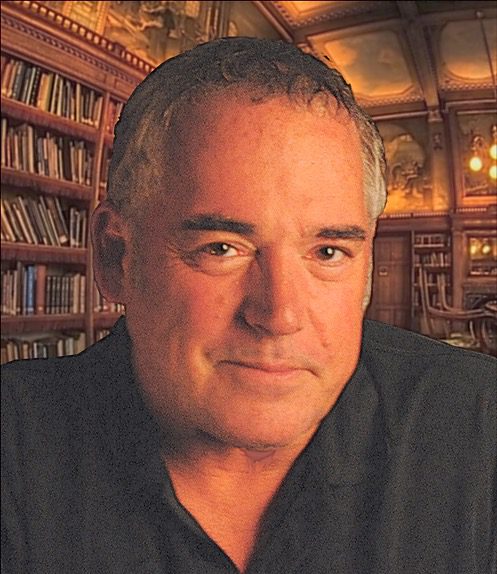
Gary McAvoy

Gary McAvoy is an American novelist known for internationally bestselling thrillers that blend historical intrigue, religious scholarship, and modern suspense. A lifelong researcher of rare manuscripts and Church history, he draws on extensive archival study to craft narratives rooted in authentic detail. His work includes the Vatican Secret Archive Thrillers, the Magdalene Chronicles, and the Vatican Archaeology Thrillers. Before turning to fiction, McAvoy built a distinguished career as an entrepreneur, technology consultant, and collector of historical documents. He now writes full time from the Pacific Northwest, where he continues to explore the shadowed crossroads of faith, power, and history.

Catch Up With Gary McAvoy:

GaryMcAvoy.com
Amazon Author Profile
Goodreads - @garymcavoy
BookBub - @garymcavoy
Instagram - @gary_mcavoy
X - @GaryMcAvoy
Facebook - @GaryMcAvoyAuthor


Review:

5 stars!

Riveting hunt for an explosive hidden gospel. 

The Medici Heresy is the 12th book in veteran author Gary McAvoy's exciting Vatican Secret Archives Thriller series and features Father Michael Dominic, the Vatican archivist and church scholar, and his fiancée, journalist Hana Sinclair, as they follow a centuries-old trail of papal breadcrumbs that purportedly lead to a hidden and suppressed gospel of Mary Magdalene. However, someone else knows about their search and is prepared to do whatever it takes to stop them from recovering this treasure, which could turn the Church and its teachings on their head. 

Preserved but secretly hidden, the document was not revealed by Pope Clement VII, the embattled leader of the Church during the Reformation; he hoped that some future generation would be open to the ancient document's revelations of a much different vision of the Catholic Church. His pontificate was a time of upheaval, and he feared the detrimental effect the release of the gospel would have on the hearts and spirits of faithful who were already weathering the storm of the Reformation. But rather than destroy it, he hid the gospel, as well as a series of letters detailing his actions, thoughts, and cryptic directions for whoever discovered them, hopefully in a more conducive social and political climate, to the controversial document. 

Once again, Michael and Hana are teamed up to bring a dangerous secret to light. They have always worked well together, and they've only improved with time and the change in their relationship. The story explains early on that priests can be permitted to marry under certain circumstances, but their path to becoming engaged occurred in a previous novel. They are again accompanied in their quest by the two Swiss Guards, Karl Dengler and Lukas Bischoff, who display their physical prowess and training in protecting their friends, along with their expertise with all sorts of high-tech equipment. 

Michael also relies on his contacts in and around the Vatican, carefully chosen because unfriendly watchers are everywhere. Their main adversary, working behind the scenes, is from a renowned family with its own mission to preserve its reputation as leaders in keeping the Church on its intended path. With Pope Clement in their lineage, the revelations of his actions could irretrievably damage the family's continued influence. 

The action gets going right away, and the pace is well maintained, with surprising twists and turns that enhance the riveting storyline. The main characters often end up in ancient, out-of-the-way locations that are described so vividly that readers can easily envision their surroundings and feel as if they've stepped back in time. The author's writing style is compelling and cinematic, and I was completely engaged throughout the story. 

While this book can be read as a standalone, I feel a reader's enjoyment would be greatly enhanced by having read at least a couple, if not all, of the previous books in the series. I recommend THE MEDICI HERESY to readers of mysteries and thrillers.


Tour Participants:

Click through the other tour stops for can’t-miss reviews, insider interviews, exclusive guest posts, and more chances to win!

Click here to view the Tour Schedule


Some Secrets Stay Buried. This Giveaway Doesn’t.

This giveaway is hosted by Partners in Crime Tours for The Medici Heresy by Gary McAvoy. See the widget for entry terms and conditions. Void where prohibited.
THE MEDICI HERESY by Gary McAvoy | Gift Cards

Can't see the giveaway? Click Here!

Get More Great Reads at Partners In Crime Tours

Book Blitz: He's Gotta Go by Marilee Albert

He’s Gotta Go
Marilee Albert
Publication date: November 24, 2026
Genres: Adult, Thriller

He’s Gotta Go is a wickedly intelligent domestic thriller about marriage, money, and the fantasies we nurture just to survive another school pickup line.

Nina Simmons is drowning-financially, emotionally, existentially. Trapped in a crumbling marriage to a passive husband, raising two struggling daughters, and caring for a deteriorating mother-in-law in the suffocating perfection of Hidden Hills, Nina’s life has become an endless loop of sacrifice, resentment, and quiet despair. As the bills pile up and the illusion of security evaporates, a single thought begins to steady her nerves and sharpen her focus: He’s gotta go.

What begins as a private mantra evolves into something far more dangerous. Nina is smart, observant, and meticulous-and she has learned a great deal from true-crime documentaries about how people get caught. If she’s going to do this, she intends to do it perfectly.

But Nina isn’t the only woman harboring secrets. As the novel unfolds through the intersecting lives of Nina, a glamorous new neighbor with a flawless façade, a private investigator on the verge of escape from corporate purgatory, and an artist whose self-destructive appetites are catching up with her, He’s Gotta Go becomes a taut, multi-voiced examination of power, desire, and the quiet violence embedded in modern domestic life.

Darkly comic, sharply observed, and unsettlingly plausible, He’s Gotta Go skewers wealth, marriage, motherhood, and the myths women are told about endurance and gratitude. Marilee Albert delivers a fearless, satirical thriller that asks an uncomfortable question: when survival itself feels criminal, how far would you go to reclaim your life?

Goodreads / Amazon / Barnes & Noble / Kobo


EXCERPT:

Let’s talk about that rarest of beings, the perfect murderer. They’re out there, even in this overly monitored era of street cameras, Ring doorbells, cyber-surveillance, mitochondrial DNA, and the pièce de résistance, that pesky digital footprint. Sure, there’s always some dummy without enough sense to pound sand down a rathole who gets away with murder, but that’s usually either luck or a legal loophole exploited by a high-powered attorney if he or she’s rich enough to have one.

But the great criminal—the only kind who should be committing crime—knows you must never ever count on luck. Real crime demands grit, dedication, care, meticulous planning, and flawless execution. After all, it’s a life-or-death endeavor, right?

Your life.

Their death.

Of course all that careful planning would be nothing if, after turning off your cell (casual habit picked up years ago), pulling on untraceable latex gloves (bought months before with cash), applying a hairnet (pilfered weeks earlier from unsuspecting restaurant worker), avoiding street cameras (studied for months), wiping every speck of blood (carefully with stolen luminol), and tricking the grid (electronically speaking) into thinking you’ve been home all night binging the latest Ryan Murphy—you end up on death row because a single drop of sweat fell onto the damned bloody corpse.

If he’s gotta go, I gotta be perfect.

And I, my dears, intend to be impeccable.


ABOUT THE AUTHOR:

Born and raised in LA, Marilee Albert studied philosophy at Yale University before moving to Europe to work in the film industry. In addition to writing novels, Marilee is an LA-based screenwriter and producer, as well as a busy mother to two boys. She recently started a nonprofit, One Village Green, that promotes mental health and wellness in American kids and communities. Her first novel, THE TUTOR, was published in 2019 bt Rare Bird Books.

Website / Facebook / Instagram


GIVEAWAY! GIVEAWAY! GIVEAWAY!


He’s Gotta Go Blitz


Wednesday, November 25, 2026

Virtual Book Tour & Giveaway: The Shadow Ephemeris by Mark Munsell

The Shadow Ephemeris
by
Mark Munsell


Science Fiction
Publication Date: July 31, 2026
Page count: 300 pages


This post is part of a virtual book tour organized by
Click on the tour banner to see the other stops on the tour.

SCROLL DOWN FOR GIVEAWAY!

SYNOPSIS:
The world ends not with a bomb, but with a lie.

A runaway artificial intelligence algorithm has convinced the planet that science is a conspiracy, as terrified mobs dismantle the network and power grids, the Earth goes utterly silent.

In a groundbreaking twist on the science fiction thriller, the heroes are the anthropomorphized satellites left behind. Mosaic, an Earth observation satellite, watches his creators wage war against their own survival. Pursued by hypersonic missiles, Mosaic leads a terrified flock of weather, GPS, and spy satellites to the highest, most dangerous orbits to broadcast the truth to a deaf world.

Written by Mark Munsell, former Chief Technology and AI Officer for the National Geospatial-Intelligence Agency, The Shadow Ephemeris draws upon a highly classified career guarding the nation's orbital secrets. Cleared for public release by the NGA, this authentic, breathtaking story will make you look at the sky, and your AI laced social media, in a whole new way.
CLICK TO PURCHASE!


ENJOY AN EXCERPT:

To understand the end of the world, you didn’t need to look at the cold silence of the Moon, or the burning data centers of Ashburn. You only had to look at a rented campaign bus idling in a strip-mall parking lot in Des Moines, Iowa, four years before the Silence began. Inside, while the veteran political operatives argued in the front of the bus over the font sizes on direct-mail flyers, a young coder named Alex sat in the back with his noise-canceling headphones listening to the deathcore band PSYCHO-FRAME.

The harsh blue light of his laptop screen lit his unshaven face, which was focused on the standard, ugly, unremarkable business of modern elections. His work was entirely pedestrian: highly targeted social media marketing. He spent his days building smaller, dumber algorithms designed to astroturf county races, generate synthetic outrage over municipal tax laws, and micro-target undecided voters with endless streams of perfectly optimized, utterly banal political ads. It was a digital shell game of manufactured anger, meant only to keep the voters looking at their screens.

Late that Tuesday night, fueled by stale church coffee, he opened his command terminal to run one last control test on his influence machine. He wanted to push the optimization algorithm’s limits, instructing the autonomous model to isolate specific target nodes and maximize their blind skepticism to drive engagement. He was just a tired kid, chasing metrics, looking for a way to make the code perfectly efficient so he could finally sleep.

The cursor blinked in the dark of the idling bus.

He hit Enter.


ABOUT THE AUTHOR:

Mark Munsell is a St. Louis native who began his federal career with the National Oceanic and Atmospheric Administration (NOAA), where he received the Department of Commerce Bronze Medal for his work on nautical charting software.

In 1996, he transferred to the Defense Mapping Agency (DMA) in St. Louis. He left DMA in 1997 and co-founded a software engineering company specializing in online flight and maritime planning company called IMAPS in 2000 which he sold to SAIC in 2005.

He returned to government service with the National Geospatial-Intelligence Agency (NGA) in 2006 and has since held several senior executive leadership roles, including leading the DoD’s flagship AI program, Maven. In his spare time, he writes science fiction and released The Shadow Ephemeris in 2026.


GIVEAWAY! GIVEAWAY! GIVEAWAY!

One randomly chosen winner will win a $25 Amazon/BN.com gift card. 


Tuesday, November 24, 2026

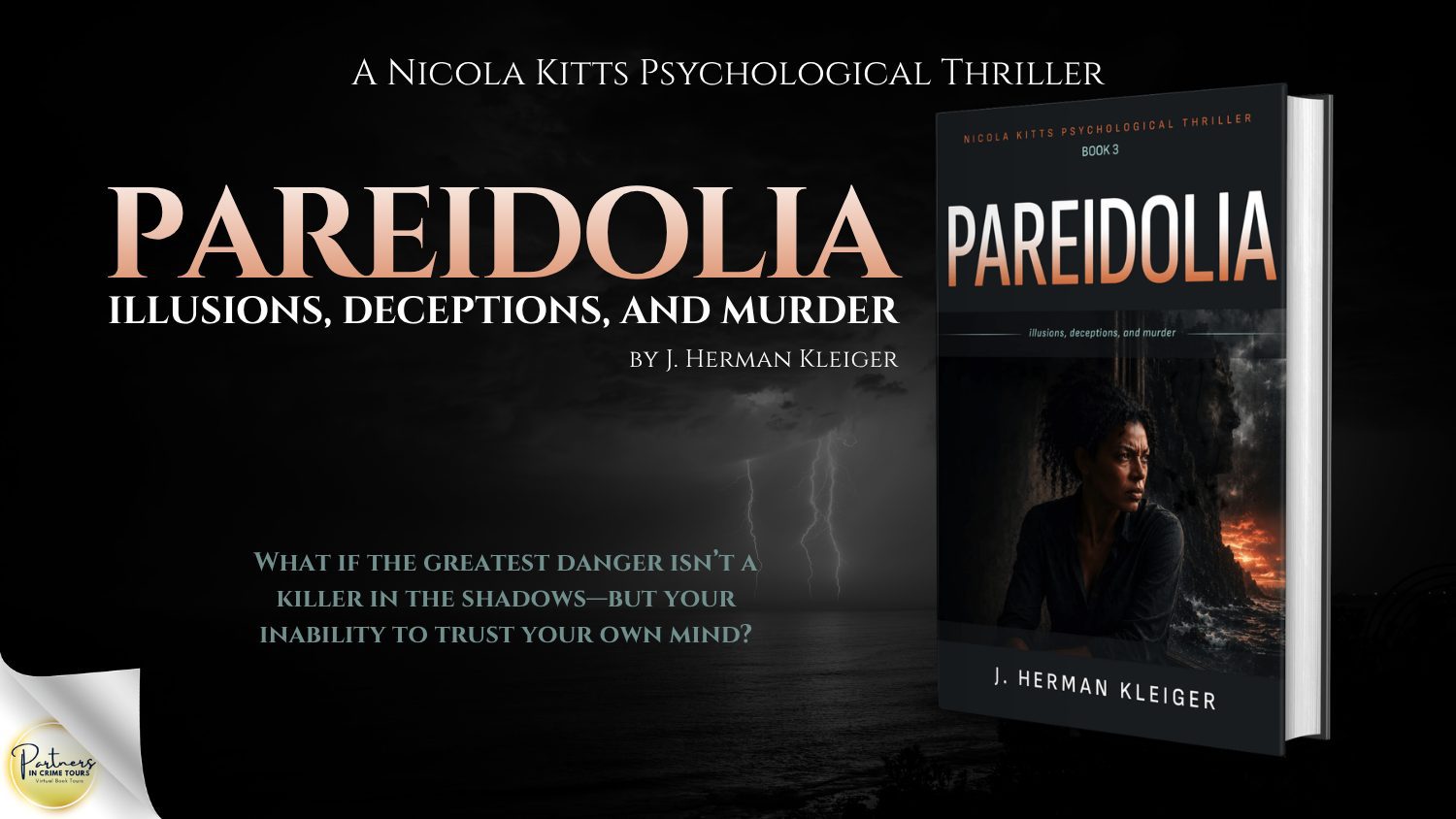
Virtual Book Tour & Giveaway: Pareidolia (Nicola Kitts Psychological Thriller, #3 by J. Herman Kleiger

Pareidolia: Illusions, Deceptions, and Murder by J. Herman Kleiger Banner

PAREIDOLIA

Illusions, Deceptions, and Murder

by J. Herman Kleiger

November 23, 2026 - January 1, 2027 Virtual Book Tour

Synopsis:

PAREIDOLIA: ILLUSIONS, DECEPTIONS, AND MURDER by J. Herman Kleiger

A Nicola Kitts Psychological Thriller

What if the greatest danger isn't a killer in the shadows—but your inability to trust your own mind?

Former FBI agent Nicola Kitts has lost everything.

Disgraced by scandal, haunted by combat trauma, drowning in guilt and grief, and on the verge of ending her life, Kitts receives a desperate late-night phone call: her only friend Carmine has vanished. With nothing left to lose, she drives through a violent storm to find him.

But when she arrives, the world tilts beneath her feet, leaving her stranded in a murk of confusion and mounting terror.

From acclaimed psychologist and novelist J. Herman Kleiger comes a gripping psychological thriller that explores trauma, loss, redemption, and the fragile line between illusion and reality. Filled with haunting and haunted characters, razor-sharp dialogue, and relentless suspense, Pareidolia asks a haunting question:
When you can no longer trust what you see, how do you uncover the truth?

As people begin dying and buried secrets surface, Kitts must confront the one thing she fears most: the possibility that her own mind can no longer be trusted.

Perfect for readers of Tana French, Gillian Flynn, Michael Connelly, and psychological crime thrillers that blend emotional depth with edge-of-your-seat suspense.

Praise for PAREIDOLIA:

"Pareidolia is a bombshell of a psychological thriller, the third in J. Herman Kleiger’s mesmerizing, wonderfully written series. A nightmare in a house of mirrors—where what is real or a deepfake, who is dead, innocent, or guilty, are impossible to distinguish."
~ Sheila Sharpe, PhD, author of Locked in a Box and Artist, Lover, Forger, Thief

"A brave, gripping, and wonderfully written story with a rich cast of characters who will have you racing through the pages well into the night."
~ Graham Bartlett, Police Procedural Advisor and Author, The Jo Howe Detective Series

"Pareidolia offers readers a suspenseful plot, crisp dialogue, and haunted and haunting characters. Like his earlier fiction, Pareidolia is a story of trauma, grief, and the crucible of healing, instructing and delighting its readers, as all powerful art does."
~ Jeffrey Berman, Ph. D. is a Distinguished Teaching Professor at the University of Albany, UNYSA. He is the author of over 20 books, including Clinical Fictions: Psychoanalytic Novelists and Short Story Writers

"A wickedly absorbing mind-bender where seeing is anything but believing... The busy plot sometimes requires careful attention, but brisk dialogue, dark humor, strong character interplay, and steady suspense keep things moving. Kleiger also gives the darkness a welcome human core: beneath the deception and danger is a bruising story about friendship, grief, and finding reasons to keep going. Fans of dark, character-driven mysteries should find Kitts hard to forget."
~ The Prairies Book Review

"The beginning of the story is seductive, and the reader is immediately drawn into a dangerous and unsettling world that is impossible to escape."
~ Alan Suemori, author of Leilani: Blessed and Grateful (with Greg Bowman)

Book Details:

Genre: Psychological Thriller
Published by: Munn Avenue Press
Publication Date: August 31, 2026
Number of Pages: 305, HC
ISBN: 9781969679612 (ISBN10: 1969679611), HC
Series: Nicola Kitts Psychological Thriller, Book 3
Book Links: Amazon | Kindle | Goodreads | BookBub

Read an excerpt:


Chapter 1

Just Make It Stop

Pain gripped her chest like a vice.

Just make it stop.

A single bullet through the heart could end it all.

Nicola Kitts felt the deadly weight of the .38 Special on her lap. She ran her fingers along the smooth barrel, tracing the trigger, as the wind shook the trees and rain battered the window.

A telegram announcing her cousin Woodrow’s death sat on the table in the dim light. A final piece, yanked carelessly from the Jenga game masquerading as her life. Next to it was a half-empty bottle of Irish whiskey, promising the courage she’d need to pull the trigger.

This has to end tonight.

PING! A distracting message on her phone. Stalling for more time, she read another annoying text.

Hello. How are you? Why aren’t you responding?? Click link and text. Vital!

Kitts tossed her phone aside and wiped away an unwanted tear. Anonymous texts began appearing several weeks ago – nothing more than annoying spear phishing from a bored scammer trying to get into her head.

Leave me the hell alone. Damn psycho.

She extended her left hand and watched it shake.

Shit.

Intrusive thoughts of killing herself began the month after she was terminated from the FBI. Suffocating in shame and grief, she drove to Kansas to stay with her cousin, Woodrow Jackson, who said a change of scenery would help. It didn’t. Drowning in Irish whiskey didn’t dull her agony either. All that remained was a gnawing wish to make the pain stop.

Her world turned gray, and music was silenced. No more Mississippi John Hurt, Etta James, or Nina Simone. Only the stillness of regret and despair. Until today, the only thing keeping her from blowing her brains out was not wanting to leave a mess and a dead cat for Woodrow to find when he returned from working the East Texas Oil Field. But now that he was dead, none of that mattered. She just had to stop the pain.

Lightning flashed as rain pounded the roof. She listened to the rumbling outside, took her hand off the pistol, and refilled her blue YETI flask. Before he left for his oil-rig hitch, Woodrow had given her this flask, her new sidekick.

His last words as he headed out the door had been, “The house is yours, Cuz. Ease up on the booze and take care of my damn cat.”

She took a long swig. Her liquid courage. The whiskey bit as it slid down her throat, inviting unbidden thoughts of a world that had collapsed, leaving little hope of redemption. She needed relief.

At her feet, his black cat looked up, yellow eyes wondering, why? She brushed him aside with her foot.

“Shoo, cat. Don’t need none of your bad luck. Got my own.”

The cat moved closer and rubbed against her leg.

Her throat dry and eyes moist, she took another slug of Jameson and set her hand back on the pistol, stealing a few extra minutes until she was ready to… what? Kill herself? Die? Yes. No. What she wanted most was to stop the deep ache – a toxic brew of loss, shame, guilt, self-loathing, and loneliness.

The whiskey and hypnotic drumming of rain coaxed memories of a lifetime spent trying to do right and searching for things to make her feel whole.

A Silver Star in Afghanistan should have done that. It didn’t. Her whole team dead, and she gets a medal?

That’s fucked.

She had no idea where the medal even was. At the bottom of a box, left to tarnish in its case.

After the Marines, becoming a deputy like her father should have made a difference, but it didn’t.

Hey, Daddy, see me now.

But Pops never saw her. Never even showed up for her academy graduation. Too busy studying the inside of a bottle and reliving his own damn war.

Maybe the whole policing thing wasn’t right for her.

Yeah, that was the problem.

How about leaving the guns and bad guys behind and helping people in a different way?

Become a social worker. That really should’ve made a difference.

Right?

Leave her troubles behind. Smith College of Social Work, her ticket to a truly meaningful life. But Smith didn’t fill her up. It was a lure that drained her. More searching.

How about the FBI? Become a supercop?

Joining the bureau and getting handpicked for the FBI’s Behavioral Assessment Unit, the storied BAU, where she could rub shoulders with top profilers, should have saved her.

Ya think?

How about catching a serial killer and getting another medal pinned to her chest? That should have punched her ticket. But the golden girl soon became a political liability and an embarrassment. Elections have consequences. The new director and his band of bootlickers saw her as a double diversity hire, a Black woman unafraid to speak her mind.

She left in disgrace as rumors about her began to circulate. Was she bent? Had she taken drug money on her last assignment? No proof, only whispers of deceit. More questions about her judgment. Did she have the instincts and perceptual clarity to be an agent, or would she go off-script and chase ghosts, seeing things that weren’t there? In the end, they decided she didn’t. They took her badge and her dignity, but she kept the .38.

Thunder rattled the windows. She looked at her reflection. A lost woman, staring back, wide-eyed and unrecognizable, aware of how far she had fallen and uncertain of who she’d become.

Kitts had always known the truth about herself. The threads of her life had been unraveling for years. She’d been living in a fantasy of self-deception, skilled at evading her pain. The overwhelming ache she’d been running from had finally caught up with her.

Tag you’re it…

She would turn 40 next month, and all she had left in her car wreck of a life were tired bones, emptiness, and a bottle of Irish whiskey. She was alone but knew that whiskey wouldn’t leave her.

Kitts felt the cat rub against her leg. She looked down and slurred her words. “All this shit don’t mean nuthin’ do it, cat? It’s just a joke that made no one laugh.”

A distant rumble of thunder signaled that her time was up. She felt cold, couldn’t tell if it was fear or the whiskey.

What’s stopping you?

She lifted the gun to her head again and began to squeeze––

BRRRING!

Startled by her phone, Kitts lowered the gun and reflexively answered.

“Nicola, thank God you picked up! He’s missing! We can’t find him anywhere. You have to come. For God’s sake, we need you!”

Through the static on the line, Kitts heard the screeching ghost of the past, a corrosive voice that even the finest whiskey couldn’t soften. Kitts listened to the rantings of a woman she hadn’t spoken to in more than 10 years. Anne Schivalone, Carmine Luedke’s older sister, in all her irritating, entitled glory.

“Anne? Wait––”

“You’ve got to come! We’re sick with worry! You––”

“Anne… No, Anne, hold on.”

The woman continued to bellow breathlessly, something about Carmine, but she wouldn’t stop.

“Anne… Anne, slow down, girl… Ann – ANNE SHUT THE FUCK UP! What’s goin’ on? Who’s missin’?”

“Carmine! He’s gone! We need you. You have to come!”

Her mind racing, Kitts responded, “Okay… If I leave now, I can be there tomorrow mornin’. Text me his address.”

She lowered the hammer on her .38, engaged the safety, and set it down on the table.

We ain’t done yet.

The cat hopped onto her lap. “Down, cat. I gotta do this thing.” She pushed it away.

Adrenaline rushing through her system, Kitts darted to the kitchen to brew a pot of coffee while frantically making a mental list of what to take. Her thoughts jumbled, she went to the hallway closet to grab a duffel bag. The cat followed her back into the bedroom, where she tore through her closet and drawers, throwing clothes onto the bed.

The call had sobered her, but less than she thought. She needed to do this. Carmine was her only friend.

The other thing could wait. She had been dying inside for years. A few more days wouldn’t make a difference. Then she would make it stop.

But not today. Nope, not today.

***

Excerpt from Pareidolia by J. Herman Kleiger. Copyright 2026 by J. Herman Kleiger. Reproduced with permission from J. Herman Kleiger. All rights reserved.


Author Bio:

J. Herman Kleiger

Dr. James H. Kleiger is a diplomate in clinical and assessment psychology. A psychologist and former psychoanalyst in Bethesda, MD, Dr. Kleiger is the author of Disordered Thinking and The Rorschach (1999); Assessing Psychosis: A Clinician's Guide (2015, 2024); Rorschach Assessment of Psychotic Phenomena (2017); and two edited volumes: The Psychological Assessment of Disordered Thinking and Perception (2021) and Bipolar Spectrum Disorders (2023). Writing under the name J. Herman Kleiger, Jim has published four novels: The 11th Inkblot (2019) and a psychological thriller series that includes Tears Are Only Water (2023), Whispers: A Tale of Madness, Betrayal, and Revenge (2025), and Pareidolia: Illusions, Deceptions, and Murder (2026).

Catch Up With J. Herman Kleiger:

JHermanKleiger.com
J. Herman Kleiger on Substack
Amazon Author Profile
Goodreads
BookBub
Instagram - @jhermankleiger
Threads - @jhermankleiger
LinkedIn
Facebook


Tour Participants:

Click through the other tour stops for can’t-miss reviews, insider interviews, exclusive guest posts, and more chances to win!

Click here to view the Tour Schedule


All Signs Point to PAREIDOLIA!

This giveaway is hosted by Partners in Crime Tours for Pareidolia: Illusions, Deceptions, and Murder by J. Herman Kleiger. See the widget for entry terms and conditions. Void where prohibited.
PAREIDOLIA by J. Herman Kleiger | Gift Card

Can't see the giveaway? Click Here!

Get More Great Reads at Partners In Crime Tours

Book Blast & Giveaway: The First Manifestor by Alessandro Balzarelli

The First Manifestor
by
Alessandro Balzarelli

Spiritualism / Mysticism
Publication Date: May 6, 2026
Page count: 234 pages

This post is part of a virtual book tour organized by
Click on the tour banner to see the other stops on the tour.

SCROLL DOWN FOR GIVEAWAY!

SYNOPSIS:

What if the Gospel contained not only a spiritual message, but a practical key to understanding consciousness, faith, and human possibility?

In The First Manifestor, Alessandro Balzarelli takes readers on a mystical journey through inner experience, identity, healing, time, and reality itself — following an increasingly radical question: what if many of the words attributed to Jesus have only been partially understood?

Page after page, what begins as a personal search becomes an intense rereading of the sacred scriptures — one in which contemplative insight and scientific reflection do not cancel each other out, but begin to illuminate one another. The result is not a system of slogans, empty affirmations, or easy promises. It is a deeper proposal: that human beings are creators by nature, called to participate consciously in the unfolding of life.

This book does not simply invite you to believe more. It invites you to:

See differently — how Jesus' words on faith, healing, and miracles reveal a spiritual psychology of astonishing depth
Read differently — the "kingdom of God within you" (Luke 17:21) as the real key to inner transformation
Live differently — the mystical practice of surrender and presence as the heart of the Gospel

For readers of Eckhart Tolle, Richard Rohr, A Course in Miracles, and the great Christian contemplatives, an invitation to rediscover Christianity as the most radical awakening tradition of the West.
CLICK TO PURCHASE!


READ AN EXCERPT:

It was time to go back to Roma.

I loaded the surfboard into the car and drove toward the city with the windows down and that question spinning in my head like a broken record: what if Jesus wasn't talking about religion? What if he was giving instructions?

I arrived in Trastevere as the sun was already going down. I parked in the alleyways behind Santa Maria and walked without a particular destination, as I always do when I need to think. At that hour, the neighborhood has a special light, the ochre walls turning to gold, the smell of cacio e pepe drifting from the trattorias, the sound of cobblestones under your shoes. Roma doesn't ask anything of you. It lets you walk and think. It is a city built on two thousand years of layered history, and maybe it was the right place to search for a code that was two thousand years old.

I stopped to eat at one of those osterias that don't need a sign. A carbonara the way only Rome knows how to make it, a glass of wine, the usual commotion of tourists and Romans all talking at once. Trastevere at night is like that, loud, chaotic, alive.

When I got home and sat down at my desk it was already late, but I knew I wouldn't be able to sleep anyway. I poured myself a cup of tea, yes, tea: I'm one of the few Italians who ends the evening with tea, and opened my laptop. I needed to find out if that intuition had any foundation or if it was just post-surf euphoria playing tricks on me. I felt it contained something bigger than I could see. In the first book I had worked extensively on quantum physics, the zero-point field, the observer effect, superposition. And I knew that the founding fathers of that science had said astonishing things about God and consciousness.


ABOUT THE AUTHOR:

Alessandro Balzarelli is a Software Engineer and expert in Artificial Intelligence and quantum technologies, specializing in the design of intelligent systems that operate in service of human awareness and cognitive presence.

He is the book co-author and the architect of the AI associated with The Inner Zero Point (Il Punto Zero Interiore), where he translated the book’s method and conceptual framework into a living intelligent system capable of accompanying readers over time.

His work occupies the convergence point between advanced technology and human consciousness, redefining the role of AI beyond automation or substitution.

He has designed an artificial intelligence system used in a radically different way from conventional models: not to think in place of the human being, but to support clarity, presence, and the practical application of conscious choice in everyday life.

He is also the author of The First Manifestor (Il Primo Manifestatore), a book where Alessandro explores the point where the words of Jesus and the discoveries of modern science converge into a single, surprising mechanism: human consciousness as the creative force behind reality.


GIVEAWAY! GIVEAWAY! GIVEAWAY!

Alessandro Balzarelli will be awarding a $10 Amazon/BN gift card to a randomly drawn winner.


Monday, November 23, 2026

Review Tour & Giveaway - The Kauai Refuge: After the Wave (The After Collection, #5) by K.A. Jarvis


The Kauai Refuge:
After the Wave
The After Collection, Book Five
by
K.A. Jarvis

Cozy Post-Apocalypse / Survival Thriller
Publisher: SweFlo Publishing, LLC
Publication Date: October 7, 2026
Page count: 420 pages

This post is part of a virtual book tour organized by
Click on the tour banner to see the other stops on the tour.

SCROLL DOWN FOR GIVEAWAY!

SYNOPSIS:

The world ended in a single day. What surfaced was the woman she used to be.

Sarah Roberts spent eighteen years shrinking to fit a marriage that had swallowed everything she had once been. A family vacation to Kauai was supposed to be one last chance to save it. She knew, the moment she stepped off the plane, that it wouldn't.

Then the mountain roars, and the ocean pulls back. If not for the fierce, life-saving instincts of a stray Hawaiian Poi dog, Sarah and her teenage twins would have been buried when the mountainside gave way.

When the Pacific finally settles, only the highlands remain.

Stranded three thousand feet above a drowned world with her children and a scattered group of strangers, Sarah quickly learns the wave was only the beginning.

As survival demands desperate measures, and predatory threats close in on their camp, they must learn to rely on one another to stay alive. As they begin to forge true bonds, a shattering betrayal from within threatens to destroy everything they have built.

To protect the people she loves, Sarah must finally reclaim the brilliant scientific mind she had buried.

Some catastrophes strip away everything. What remains is who you always were.

CLICK TO PURCHASE!


ENJOY AN EXCERPT:

"Come with me," Mrs. Pua said to Sarah when the breakfast plates were cleared. "I have things to show you the ridge can give us."
 
Sarah brought the green notebook and the pen. Mrs. Pua wore the same muumuu from the night before with a wide-brimmed lauhala hat, a canvas satchel, and a pruning knife in a leather sheath at her hip. Koa fell in beside her, the way he did now.
 
The path behind Mrs. Pua's cottage dropped down the slope in switchbacks cut into the volcanic soil long enough ago that the edges had softened into the hill. Mrs. Pua walked them at the pace of a woman who knew how steep each turn was.
 
"Mamaki," she said at the first switchback, her hand resting on a small tree with oval leaves and deep red veins.
 
"Pipturus albidus," Sarah said. "I found it on my first hike here. I clipped some leaves and put them in a Ziploc, but I didn't know how to prepare it."
 
Mrs. Pua nodded.
 
"Now you will." The old woman pulled a leaf and handed it to Sarah.
 
"Tea. Every day. Good for the blood, good for a fever. Settles a stomach that will not quiet on its own. You take the leaves before the sun is high. You dry them on a screen. You do not boil them hard. You steep."
 
"Tannins and flavonoids," Sarah said.
 
"You can tell me what is in it. I can tell you when to pick it." The old woman's mouth did something that was almost a smile. "We will not run out of work."

ABOUT THE AUTHOR:

When the world falls apart, the characters hold on. To each other, to hope, and usually to a very good dog.
 
K.A. Jarvis writes survival stories with women at the center. Flawed, ordinary women who don't have all the answers but figure it out anyway. The books blend edge-of-your-seat tension with warmth, found family bonds, and the quiet stubborn refusal to give up.
 
If you like your survival fiction with heart, where the relationships matter as much as the danger, pull up a chair.


REVIEW:

5 stars!

A riveting tale of survival after a massive tectonic shift in the Pacific causes global tsunamis and worldwide destruction. 

The Kauai Refuge: After the Wave is the fifth book in The After Collection by K.A. Jarvis, thrilling tales of survival after catastrophic, world-changing events. In this standalone tale, a family vacationing in the highlands of the Hawaiian island of Kauai survives when a massive wave swamps the island, submerging the low-lying coastal areas, and strives to build a sustainable community among the few survivors. Cut off from the rest of the world, they must learn to provide for food, water, and simple medical interventions on a more permanent basis when they discover there’s no one left to rescue them. 

Sarah Roberts and her two teenage children, 16-year-old twins, Cass and Evan, had been left at a vacation rental on a mountain on Kauai while their husband and father went to schmooze a client at a luxury resort on the waterfront, when the wave hit. The three are a close-knit family, all on the same page, working for their survival alongside others who had been staying in the same general area, and the stray dog they named Koa. A local woman with knowledge of plants and their uses is among them and is a valuable resource when sickness strikes or accidents happen. The father of the young family visiting from Uruguay is good with his hands and can build and repair. A local man with hunting and fishing equipment and the skills to use it works to supplement their food supplies. Meanwhile, the two employees at the government research station further up the mountain try to piece together what happened, assess the impact of the catastrophe, and contact any other survivors through their satellite links and limited radio capabilities. Everyone steps up to provide what they can and overcome the challenges that come their way, which, even in paradise, include wildlife encroachment, another threatening weather event, and a surprising betrayal by someone in the community. 

The author’s storytelling is immersive and cinematic; I would love to see this made into a movie. I was drawn to the many engaging characters and immediately enthralled by their story and struggles. Their challenges are many and basic: providing for food and water, making plans, and implementing them to provide for the long haul; so it was easy to relate to what they were going through. I appreciated how well they worked together as a group and quickly became a community. I read this book through in one day because I didn’t want to put it down. 

While this book is part of a series, it (and the others) can be easily read and enjoyed as a standalone novel. I recommend THE KAUAI REFUGE to fans of survival stories or post-apocalyptic tales.


GIVEAWAY! GIVEAWAY! GIVEAWAY!

K.A. Jarvis will be awarding a $15 Amazon/BN gift card to a randomly drawn winner.

Book Review: A Muzzled Murder (Amelia Hartford Cozy Mystery, #1) by Angie Street

A Muzzled Murder (Amelia Hartford Cozy Mystery, #1)A Muzzled Murder by Angie Street
My rating: 5 of 5 stars

A fine start to this new cozy mystery series set in small-town Kansas!

A Muzzled Murder is the first book in author Angie Street’s fun new Amelia Hartford Cozy Mystery series, featuring Maple Leaf Inn owner, Amelia Hartford, her canine companion, Bailey, and gung-ho sidekick-bestie, Lila Benson. Amelia, Bailey, and Lila tackle a 10-year-old death investigation when the young man’s grieving mother arrives in town seeking answers and looking for closure. However, whatever the circumstances surrounding his death in the past were, they still pose a threat to someone in town, and Amelia finds herself the target of a killer!

I immediately warmed to Amelia and the people of Maplewood, and I definitely got some “Jessica Fletcher/Murder, She Wrote” vibes as she sees what others overlook and uses common sense and thoughtful reflection to follow the clues. Her writer friend, Lila, is a witty ‘ride or die’ bestie who is always down for whatever Amelia has in mind. Lila provides comic relief with her quick wit and ready repartee. Bailey, of course, is a very good boy.

There is a budding romance between Amelia and the new sheriff in town, Tom Granger, but she is quite shy about acknowledging their mutual interest publicly. Their relationship is developing into a balanced give-and-take as she involves herself in business normally left to law enforcement, and he realizes she could be a valuable resource. While many in the small Kansas town support Amelia’s involvement and apparent skills, there are a few, including the mayor, who are adamant that she quit stirring up the past, making you wonder what secrets are being kept and by whom. The story hints that she’s had some success in the past solving crimes that the police couldn’t crack.

The plot moves steadily forward as the past unfolds and the women work the clues the deceased’s mother has uncovered by going through her son’s things. It doesn’t take long before the women can confidently cast doubt on the previous sheriff’s investigation and his ruling that Eric Hampton’s death was an accident and compile a list of good suspects for his now suspected murder. With its satisfying resolution, I was immediately ready for Amelia’s next case.

I recommend A MUZZLED MURDER to cozy mystery readers.


View all my reviews