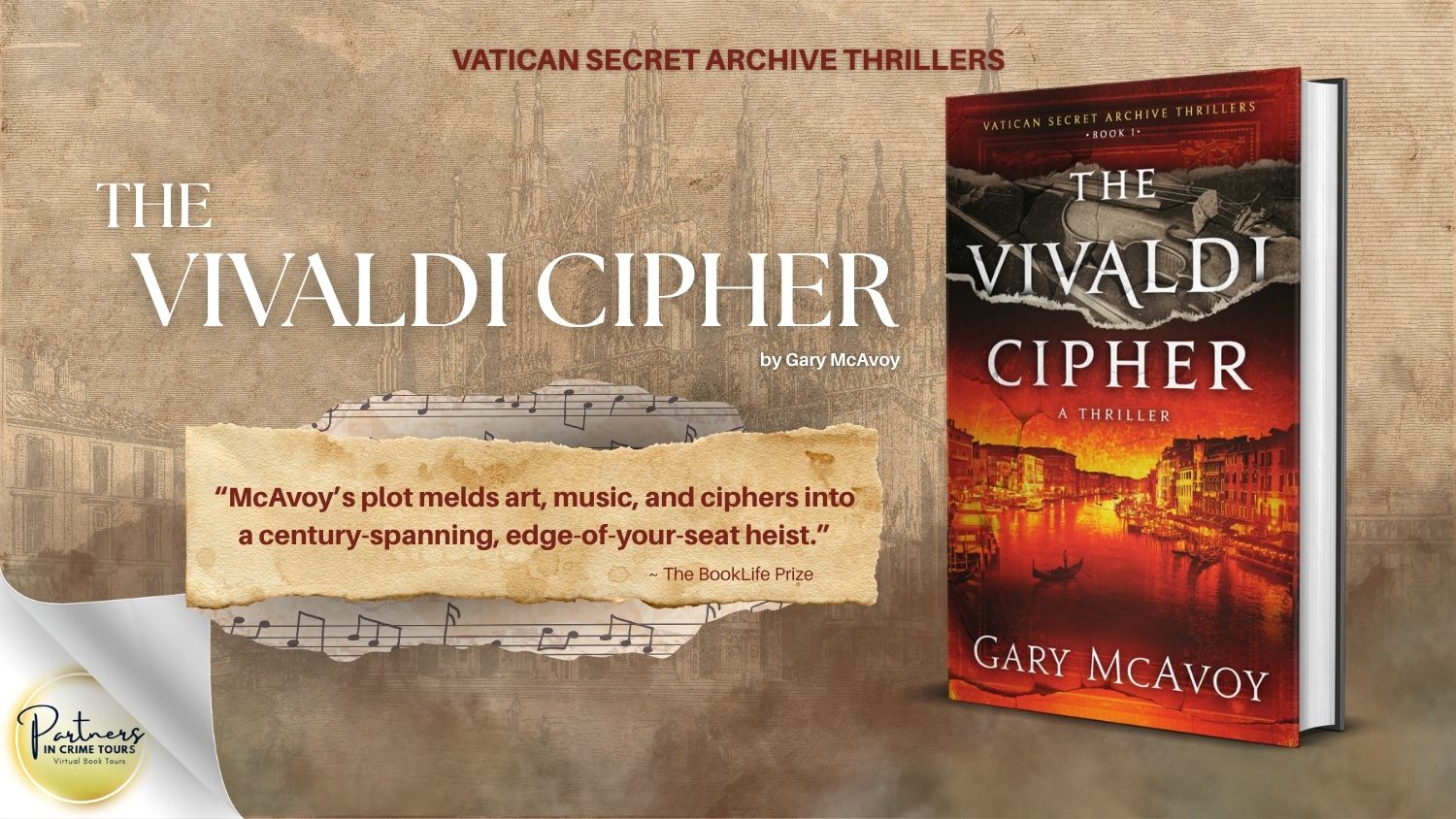
THE VIVALDI CIPHER
by Gary McAvoy
May 4 - 29, 2026 Virtual Book Tour
Synopsis:
VATICAN SECRET ARCHIVE THRILLER SERIES
During the election of a new Pope in the mid-18th century, famed violinist Antonio Vivaldi learns of a ring of art forgers who are replacing the Vatican's priceless treasures with expertly-painted fakes. Desperate, the composer hides a message in a special melody, hoping someone, someday, will take down the culprits . . .
Nearly three hundred years later, the confession of a dying Mafia Don alerts a Venetian priest to a wealth of forged paintings in the Vatican Museum, and the key to their identities lies hidden in a puzzling piece of music. Father Michael Dominic, prefect of the Secret Archives, investigates, and is mystified when he finds a cipher in an old composition from Vivaldi. Desperate to stop this centuries-long conspiracy, he calls on fellow sleuth Hana Sinclair and Dr. Livia Gallo, a music cryptologist, to help him crack the code and learn the truth.
But the Camorra, a centuries-old Italian Mafia clan, won't stand by while some interfering priest ruins their most lucrative operation. Along with a French commando and two valiant Swiss Guards, Dominic explores the dark canals and grand palazzos of Venice to uncover the evidence he needs to stop the sinister plot. Can he unearth it in time, or will the Church's most valuable artworks fall prey to this massive conspiracy?
Praise for The Vivaldi Cipher:
"McAvoy’s plot melds art, music, and ciphers into a century-spanning, edge-of-your-seat heist. Historic and modern clues meld together perfectly, and the complex workings of church and mob hierarchies combined with character relationships elevate the story. McAvoy’s prose is both clear and direct, serving the story well. Clever dialogue and unique character voices make the novel shine even brighter."
~ The BookLife Prize
"...[The Vivaldi Cipher] is gripping and hugely interesting, and the intrigue lies in the intelligent mystery of the cipher hidden in an unusual musical composition by former priest Antonio Vivaldi."
~ MJV Literary UK
"McAvoy concocts a wonderful thriller with a powerful narrative push that is like few books I have seen before. Short chapters and clipped dialogue keep the reader pushing ahead, fueled by a plot that is full of twists at every turn. I could not stop reading and found myself bingeing just to get through this book, more out of addiction to the story than anything else."
~ Matt Pechey, Reedsy Discovery
The Vivaldi Cipher Trailer:
Book Details:
Genre: Suspense, Suspense Thrillers, Historical Thriller
Published by: Literati Editions
Publication Date: August 16, 2021
Number of Pages: 400
ISBN: 9781954123076 (ISBN10: 1954123078)
Series: Vatican Secret Archive Thrillers, Book 1 | Learn More: Amazon | Goodreads
Book Links: Amazon | Kindle | Barnes & Noble | BookShop.org | Goodreads | BookBub | Audible
Read an excerpt from The Vivaldi Cipher:
Prologue
Vatican City, Rome – February 1740
The first symptom of the poisoning began as a fever.
Sitting at one of two long, white-silk-draped tables in the Sistine Chapel, along with sixty-seven of his fellow cardinal-electors, Pietro Ottoboni cast his vote for pope on the eighth day of the conclave to replace the late Pope Clement XII.
Enfeebled by fever, the seventy-three-year-old Ottoboni made his way toward the front of the chapel to a small altar below Michelangelo’s majestic fresco The Last Judgment, dropped his ballot onto a brass saucer, then tipped the saucer, letting the ballot fall into the large brass urn beneath it.
A few moments later, having returned to his seat, the cardinal collapsed onto the table, the high temperature having sapped his energy. Shocked, the other cardinals stood to better see what was happening to their colleague. The master of papal liturgical celebrations suspended the conclave while they moved Ottoboni to his apartment under the care of a Vatican physician.
Long considered favorite among the papabili to succeed Pope Clement, Pietro Ottoboni was born in the Most Serene Republic of Venice to a rich and noble family, whose most distinguished member was his grand-uncle, Pope Alexander VIII. Ottoboni had held every important post in the Vatican during an illustrious career and, as cardinal-bishop to several churches in Italy, his annual salary exceeded fifty thousand gold scudi—the present-day equivalent of six million dollars per year.
Cardinal Ottoboni had been a prolific paramour with a countless number of lovers, many of whom were married to the great patricians of Venice. In fact, the famous masks unique to Venetians were introduced not to ward off the plague, as many later believed, but to officially disguise the wearer’s identity—thus permitting anyone, noble or peasant, to do or say whatever one pleased. With this ingenious permissiveness, affari di cuore—affairs of the heart—were as common as the fleet of gondolas plying the canals of the celebrated city, without legal recourse. Having taken full advantage of this liberal device, Cardinal Ottoboni was known to have produced up to seventy children in his lifetime among his various mistresses.
Though he lived well in Rome’s grand Palazzo della Cancelleria, Ottoboni’s greatest passions were music and art, and he was a generous patron to some of the most renowned masters in both fields: Arcangelo Corelli, Alessandro Scarlatti, Giuseppe Crespi, Tintoretto, Paolo Veronese—and most of all, to his close friend and protégé, the prodigious maestro di violino of Venice, Antonio Vivaldi.
As he lay on his deathbed, Ottoboni summoned Vivaldi to his side. In a low, rasping voice, the cardinal confided to his friend a tale of great importance, a scandalous operation run by the notoriously corrupt Cardinal Niccolò Coscia in league with the feared secret Mafia organization known as the Camorra.
In fact, he added with struggling breath, he was convinced it was Coscia, acting on orders from the Camorra, who had poisoned him to keep him from acting on what he knew. With information gleaned from one of his many spies, Ottoboni had discovered the ongoing scandal days earlier and approached Cardinal Coscia with a warning that he and his Camorra would soon be out of business, at least as far as the Vatican was concerned. Were it not for his required attendance in the papal conclave, he would have put a stop to it sooner, especially if he was elected pope, an elevation to supreme power that was expected by everyone.
The following day, however, Cardinal Ottoboni succumbed to the poison, killed for a secret now known only to Antonio Vivaldi.
Like most Italians, Vivaldi survived cautiously within the Camorra’s Venetian sphere of influence. The secret society’s tentacles reached into everyone’s life, and their strict enforcement of the seal of omertà—the sacred code of silence—ensured clan activities remained discreet and wholly within la familia. The family.
Since the late seventeenth century, the Camorra had carved out its territories, starting in Naples and moving northward into the Lombardy and Veneto regions of Italy, encompassing its most lucrative prizes, Milan and Venice. Competing with La Cosa Nostra in Sicily and the 'Ndrangheta of Calabria, the Camorra’s criminal enterprises included prostitution, gambling, smuggling, kidnapping, and art theft—but also the unusual niche of producing and selling fine art forgeries of the highest order.
During the earlier reign of Pope Benedict XIII, who cared little for managing his vast realm of Papal States, Cardinal Niccolò Coscia oversaw all Vatican government operations, taking advantage of his authority to carry out substantial financial abuses, virtually draining the papal treasury. But his ongoing misdeeds eventually caught up with him. In 1731, he was charged with corruption, tried and convicted to ten years' imprisonment, and excommunicated from the Church.
However, still not without influence, he managed to get his heavy sentence commuted to a mere fine. He was also mysteriously reinstated as a cardinal, allowing him to take part in the papal conclave of 1740—the one during which Cardinal Ottoboni had died.
* * *
With Ottoboni out of the way, Cardinal Niccolò Coscia could now carry out his master plan without hindrance. In his not-so-secret role as capo of the Roman Camorra, Coscia led development of the Veneto branch of the Mafia clan, based in Venice and headquartered in his own newly acquired Palazzo Feudatario on the Grand Canal. Purchased with funds he had discreetly absconded from the Vatican treasury, Feudatario would be a most fitting place to carry out his planned forgery operation of the Vatican’s most profound works of art.
Niccolò Coscia was a meticulous diarist and, owing to all the business he conducted outside the Church, he had created the first book to record the activities of his new organization, naming it Il Giornale Coscia della Camorra Veneta—The Coscia Journal of the Veneto Camorra. In it he would secretly record careful notations of all paintings by artist and title, including each work’s provenance and to whom the forgeries or originals were sold, depending on which he chose to return to the Vatican—for many were prominently displayed in public, while most were simply returned to the Vatican’s vast art storage vaults, unseen by anyone.
The Coscia Journal would be passed down to each capintesta, head of the Veneto Camorra, for generations.
Unfortunately for Coscia, Cardinal Ottoboni’s spies had discovered not only the Camorra’s abhorrent plan for art forgeries, but the very existence of the Coscia Journal for recording such transactions. At that point Ottoboni’s death was preordained, for no one could ever know such proof existed.
* * *
Antonio Vivaldi, who at age twenty-five was ordained a Roman Catholic priest, was now at a crossroads. He feared possessing knowledge of the treacherous secret passed on to him by his esteemed patron in his dying moments. Putting himself at odds with the Camorra was not just an unappealing prospect; it could end up costing him his life, depending on what he did with what he knew.
But Cardinal Ottoboni had one last request of his protégé.
Intent on stopping the sinful and unlawful activities of Cardinal Coscia, Ottoboni had pleaded with Vivaldi to see that Coscia was brought to justice, to pay for his felonious actions. Distressed by letting his friend and mentor die without the satisfaction of such a promise, Vivaldi agreed to do what he could. He would ensure that the authorities were informed, the Coscia Journal would be found, and the matter would be settled.
After the cardinal’s stately funeral, Vivaldi waited for the right moment to fulfill his promise. But as he waited, he became more apprehensive. He was just a lowly priest, after all, and not a very good one at that. The violin was his life, and teaching it was his life’s work. Besides, who would believe him? Where was the proof? And what would the Camorra do to him if he were to expose its business? He had seen the results of their retribution—those who crossed the Mafia were dealt with harshly. Beheadings were not uncommon, and those who weren’t beheaded were drawn and quartered—alive. No, he must find a way to honor his pledge without exposing himself to such horrible consequences.
An idea came to him: he would hide the messages in plain sight, in his musical compositions.
Picking up a sheet of staff lined manuscript paper, Vivaldi began to assemble the first of many, his Scherzo Tiaseno in Sol.
* * *
Venice, Italy—Present Day
An enormous flight of pigeons, hundreds of them, flocked overhead, diving for potato chips and bits of bread sticks tourists had enthusiastically tossed out for them, as Father Michael Dominic and Hana Sinclair made their way across the Piazza San Marco.
Despite the ban on pigeon-feeding in St. Mark’s Square, little children were oblivious to the law and more amused by the flapping gray-and-white spectacle than frightened by the few gendarmerie patrolling the square, whose policing efforts to stop the feeding were futile. Venetian health experts estimate over 130,000 pigeons had roosted in the historic center—well over optimal concentrations for such a small public space—and efforts to rid the city of the determined birds had failed miserably. The damage to the marble buildings and statuary was considerable, not to mention possible pathogenic health hazards.
Locals knew it was often prudent to cover one’s head with a newspaper or magazine when crossing the vast piazza, lest strollers subject themselves to the inevitable bombardment of bird droppings from above.
An old hand at the practice, Father Dominic had kept pages of the newspaper he had read at breakfast for that very purpose, knowing he and Hana had to cross the piazza in order to get to Venice’s Biblioteca Marciana, the Library of Saint Mark.
The director of the library had requested the Vatican’s help with a planned exhibition of manuscripts held in its stacks, and as Prefect of the Vatican Secret Archives, Michael Dominic had accepted the invitation, while also taking a week’s vacation time in the fabled city. At only thirty-one years old, his access to the Vatican’s vast number of historical manuscripts still humbled him. The Biblioteca Marciana was yet one more repository of ancient wonders that fascinated him.
Lovingly named La Serenissima by Italians devoted to its “most serene” natural and historical wonders, Venice was also Michael Dominic’s favorite city in the world. He loved its vibrancy, its rich history as a major world trading port up to and through the Renaissance period and, of course, the inherent romantic nature of the people and their ancient ways.
“I’m so glad you could join me, Hana,” Dominic said as they walked through the piazza. “Have you ever experienced Carnivale before?”
Holding the newspaper awkwardly over her stylish wide brim straw hat, Hana replied with a contented sigh. “I was here once, years ago, but Carnivale had just ended. I’ve been meaning to be here for the real festivities for some time now, and since my editors wanted a piece on the celebration for Le Monde’s Weekend Section, I volunteered for the assignment.”
She looked up at the priest and smiled. “Thanks for letting me tag along with you, Michael. I don’t mind that you have a little business to attend to. I need some time off myself and can always float around in a gondola and take notes while you’re occupied.”
Dominic laughed as he removed the newspaper from over his head, having passed the worst pigeon zone. He took Hana’s paper and tossed them both in a trash receptacle alongside the library façade. “I can just see you now, laid out on a shiny black gondola, that fetching hat drawing everyone’s eye as you cruise the canals. A fashion photographer’s dream. But let’s have some fun together while we’re here as well.”
“Agreed. I can get some writing done after dinner each night,” she said with a sly grin. “So, what’s in this library that you’ve been asked to weigh in on?”
“I’m meeting with Paolo Manetti, the curator of the Marciana’s Cardinal Bessarion Library, a special wing containing the original founder’s collection of books and precious manuscripts from 1468. The Vatican has an original translation of Homer’s Iliad, a companion version to his Odyssey, but the Marciana has the oldest actual texts of the Iliad. Manetti has asked me to consider lending ours to the Marciana for a temporary exhibition on Homer. They also have the only autograph copy of commentary on the Odyssey from the twelfth century, so it should be a fine showcase.”
Fascinated as she was by Dominic’s explanation, Hana’s eyes glazed as the warm sun took hold of her, her white cotton midi skirt fluttering in the light breeze. They had passed the tall brick Campanile and were now walking through the piazzetta between the Marciana Library and the Doge’s Palace, heading toward the entrance to the Grand Canal. It wasn’t quite noon yet, the appointed time for Dominic’s meeting, so they settled onto a stone bench near the traghetto, the gondola landing overlooking the Church of San Giorgio Maggiore on the island across the lagoon. Vaporetti, gondolas, and sleek mahogany water taxis plied the calm waters as they sat there, each in their own dreamy state of mind, an effect Venice had on every visitor.
As the tower bells of the Campanile struck twelve, Dominic leaned back for a deep stretch to rouse himself, then stood and reached out for Hana’s hand to help her up. With one last glance over the lagoon, they headed toward the library.
Chapter 1
Present Day
The entrance to the Marciana Library Palace—heavy wooden doors flanked by two larger-than-life Greek marble statues—opened into the opulent vestibule, where a two-flight staircase took visitors to the upper loggias.
Looking up as they walked the marble halls, Hana fixated on the ceiling, which featured twenty-one roundels, circular oil paintings by seven notable Renaissance artists commissioned in 1556. They looked as fresh today as at the time they were painted, Hana mused, overwhelmed by their unusual spherical beauty. Reaching one of the reading rooms, sunlight streamed in from the high glass ceiling, bathing the three-story room in a diffused natural light. Surrounding the reading tables on all sides were a series of Doric arches with a handsome frieze on one wall featuring rosy-faced cherubs and garlands of fruit and flowers.
A slim, well-dressed man with long, black hair who looked to be in his fifties was walking toward them, a welcoming smile on his face. Dominic smiled in response as the man approached.
“Padre Michael, welcome back to the Marciana!” he beamed as he extended his hand.
“Paolo! What a great pleasure to see you again. This is my friend and colleague, Hana Sinclair. Hana, this is Paolo Manetti, curator of the Bessarion Library here.”
The three exchanged handshakes and pleasantries. Then Manetti turned, gesturing for them to follow him.
“We’ll be using my private office to view the Iliad. Better to keep tourists from flocking around us. I already have it set up.”
He led them through the upper loggia and down a corridor leading to various offices, entering a corner room that overlooked the piazzetta and the lagoon.
“Not only do you have a stunning library here, Signor Manetti,” Hana remarked, “but you probably have the best office in the building!”
Manetti grinned shyly. “Please, call me Paolo, Miss Sinclair. And yes, I am very fortunate to have such a wondrous place to work. What you see around you is my life. Like our friend Michael here, my love for antiquities of the Old World has no bounds.”
Dominic nodded in agreement, then turned to his companion. “Hana, if you’d like to better explore the library while Paolo and I are working, please feel free. We should only be a half hour or so. Take it all in; it truly is a marvelous old building filled with treasures you won’t find anywhere else.”
“I’ll do that, thanks. Just come find me when you’re ready.” Hana turned and left the office, making her way back to the reading rooms and their glorious artworks and statuary.
A large table in the center of Manetti’s office held several reference books, various implements for examining documents—a digital microscope, magnifying glass, blacklight, leather sandbag weights—and several large parchment manuscripts which had been laid out on it. One in particular was the chief item of interest: the only copy of the commentary on Homer's Odyssey written entirely by the hand of the author.
Putting on a pair of white gloves, Dominic handled the manuscript guardedly, gazing at the beautiful script by the hand of Eustathius of Thessalonica, the Byzantine scholar and rhetorician of the twelfth century.
“This is our finest treasure, Michael, and one of the oldest in the library,” Manetti said. “It will be one of the principal features of our exhibition. But now, look at this.”
With a gentle flourish, he reached across the table and pulled over two comparable manuscripts.
“These are Venetus A and Venetus B, the oldest texts of Homer's Iliad, with centuries of Greek scholia written in the margins.”
As Dominic recalled, since the first century, ancient commentators known as scholiasts would insert grammatical or explanatory notations, even critical commentary, in the margins of the manuscripts of early authors. Over time, centuries in fact, successive copyists or those who owned a particular manuscript altered the scholia, and sometimes the practice expanded so much that there was no longer room for scholia in the margins, so it became necessary to produce them as separate works. No copy machines, just dedicated scribes working with Egyptian reed pens and feather quills to patiently reproduce one-of-a-kind originals.
“These are truly extraordinary, Paolo,” Dominic declared, his hands shaking slightly as he held the ancient parchments. “I can certainly see why you’d want to share these in your exhibition. I can confidently say the Vatican will cooperate in any way we can. I’ll make arrangements for the original translation of Homer’s Iliad to be couriered to you when I return to Rome. I assume you’ll have appropriate security arrangements in place?”
“Of course, Michael. Apart from our own security detail, the federal Carabinieri has offered to provide full protection for us. We are simply the custodians of these masterpieces, but they are part of Italy’s proud heritage and the government takes that responsibility quite seriously.
“And thank you for your generous contribution, Michael,” he continued. “Your Iliad will be in excellent hands, I can assure you.”
“When we spoke last week,” Dominic said, “you mentioned another piece you wanted to discuss?”
Manetti turned somber. “Yes, there is something else I need to show you, and I’d like to get your opinion on it. This came to us recently from a local donor who wishes to remain publicly anonymous, and while its value is undeniable and a welcomed donation to our collection, I am not quite sure what to make of its meaning.”
The curator rummaged about the other manuscripts on the table, his gloved hands repositioning each document carefully, until he found what appeared to be an autograph musical manuscript, with staff lines and bars of musical notations, placed inside a small Mylar protective sleeve. While it was in relatively good condition, given its apparent antiquity, its corners had been chipped and there were many creases across the paper, as if someone had folded it many times at some point. Its size was quite small, a half sheet of standard paper at most.
“Well, this looks interesting, though I must admit I know little about musical manuscripts. Who is it by?” Dominic asked.
As he peered closely at the manuscript, Hana returned from her brief tour of the library and walked up to stand silently next to the two men. She glanced at the object of their attention while Manetti continued.
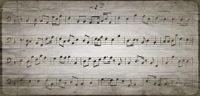
“This, my friend, was penned by the hand of Venice’s own maestro di violino Antonio Vivaldi. He gave it the title Scherzo Tiaseno in Sol, and it appears to be a scherzo in the truest, most literal meaning of that word—a joke! It is a fair enough piece of music, but nowhere near the level one would expect from a Baroque master like Vivaldi. If it is a joke, then the question is, why? And for whom? There must be more than meets the ear.
“This is marked as page two, so there may still exist a page one somewhere. The donor was rather circumspect on the matter, but as Vivaldi was her sixth great-grand-uncle, the provenance is well established.” Manetti looked up at Dominic questioningly and shrugged.
As Hana read the notes, she weighed in. “You’re right, Paolo. This isn’t anything close to what Vivaldi was known to have composed. And scherzos are normally in three, like a waltz, but this has the bar lines in the wrong place. There must be some other meaning to it.”
“You read music?!” Dominic asked her, somewhat taken aback.
“Of course, I studied music for years at St. Stevens School, and I play both the piano and cello,” she replied, a shy smile playing across her face.
“Will wonders never cease with you?” Dominic asked, grinning mischievously.
“Oh, please,” she said modestly. “We all have our secret talents. And I can hardly travel around with a cello.”
Turning to the curator, she asked, “Paolo, may I have a closer look at this?”
“Of course, signorina,” he said encouragingly.
Hana accepted the Mylar sleeve from Dominic and took a seat by one of the windows. Reading the music, she hummed the notes, emitting a series of high, low, and mid-range sounds which produced no tune whatsoever.
“Okay, this is really strange. There is nothing here that might even imply that an artist with Vivaldi’s genius was creating anything good, much less great. But why would he do that? From what I know, he wrote beautiful music feverishly, wasting not a precious second on something like this. But there must be a reason.”
“I completely agree, signorina,” Manetti said, nodding. “But what are we to do with this? We must have some kind of explanation for such an artifact if we are to display it.”
Hana had a thought. “Paolo, can you make a copy of this for me? I have an old friend, Dr. Livia Gallo, my former music teacher at St. Stevens, who is an expert in Vivaldi and other Baroque masters. Maybe she has some idea of what this might represent?”
Manetti was delighted. “Yes! I would be happy to provide you with a copy if it helps to better understand this. You must assure me that you will not share it with anyone else except your colleague, yes? Until we understand it better, I wouldn’t want speculations to be awkward for our donor.”
“Yes, of course, only Dr. Gallo will see it. For that matter, it’s small enough that I can just take a photo of it with my iPhone. Would that be acceptable?”
“Better yet,” Manetti replied. “That way there are no loose copies to get lost. Oh, and please do not use the flash.”
Hana returned the manuscript to the table, removed her phone from her bag, then took a full frame shot of the piece under natural light.
“Paolo,” Dominic asked, “might we get an introduction to your donor, this Vivaldi descendant? Hana and I may be able to get more relevant information from her that can assist Dr. Gallo. Where does she live?”
“Here in Venice, in one of the great palazzos on the Grand Canal. I don’t think the contessa would mind at all, actually. She’s quite the conversationalist.”
“A contessa?!” Hana asked, surprised.
“Oh yes, she comes from a very old noble line herself and married well, besides. Contessa Donatella Vivaldi Durazzo. She must be in her eighties now, a delightful woman, very generous in her philanthropy. She is one of the jewels of Venice, a wonderful patron of the arts, adored by everyone. She lives in Palazzo Grimaldi in the Dorsoduro, not far from the Guggenheim Museum. I would be pleased to make an introduction.”
“Excellent! We’ll be here all week, Paolo, and it would be a treat to see one of the famed palazzos on the Grand Canal,” Dominic said excitedly. “Not to mention meeting Italian nobility.”
Manetti smiled assuringly at his old friend.
“We’re staying at the Ca’ Sagredo, Paolo,” Hana said. “You can reach us there, but here’s my mobile number if you need us at any time.” She wrote down her number on a slip of paper and handed it to Manetti.
“Grazie, signorina. I will make the call this evening and let you know when she is available.”
“Where to now?” Hana asked Dominic as they left the building, having said their goodbyes to Manetti.
“I thought we’d have a bite of lunch at Quadri, then saunter over to St. Mark’s Basilica and say hello to a friend of mine from my seminary days. We’ve come all this way, and I’d hate to miss seeing him.”
“Lead the way,” Hana said breezily, placing her wide-brimmed straw hat back on her head. “I’m ready for some fresh seafood, aren’t you?”
“You bet. Just watch out for pigeons, though, as I’ve tossed the newspapers.”
Chapter 2
Among the many fine palazzos lining the Grand Canal is an understated, three-story ocher palace, somewhat more slender than its neighbors but nonetheless impressive. Its more observable features include a grand entrance off the gondola traghetto, with a black, scalloped awning over the brick staircase leading up from the water’s edge; several full-width balconies with ornamental balustrades at each end; heavily draped, arched picture windows overlooking the canal—and a cadre of armed security guards posted around the grounds of Palazzo Feudatario.
As a glossy mahogany water taxi approached the dock, two beefy men appeared from the palazzo’s entrance to greet the sole visitor on board, a priest called to administer last rites to the dying master of the house—a man known to all of Venice as Don Lucio Gambarini, the capintesta, or head-in-chief of the Veneto Camorra.
A stout man in his sixties, Don Gambarini had suffered a paralyzing stroke some weeks prior, and as his health had further declined, his death was not unexpected. In the meantime, the capintriti, heads of the twelve districts under Don Gambarini’s leadership, had assembled in the grand house, set to squabbling as to who would take over as leader of the clan when the great capintesta met his end.
But that was hardly on Gambarini’s mind when Father Carlo Rinaldo entered the formal master bedroom to hear the Don’s confession and administer extreme unction, the final anointing with last rites before death. Rinaldo had never met Gambarini before, though he was aware of the Don’s reputation, one deserving of a robust confession if he were truly repentant.
The large, well-appointed bedroom had many people standing around, vying for the boss’s attention should he wish to suddenly name one of them as his successor. But Gambarini would have none of it yet, demanding the bedroom be cleared except for the priest, who would hear his confession privately.
As everyone ambled out of the room, giving each other dark glances, the door was closed as Rinaldo placed a violet stole around his neck, then reached into his black leather bag and withdrew a small bottle of holy water, a crucifix, and his Bible.
“Don Gambarini, my name is Father Rinaldo, from St. Mark’s. Do you wish to make a confession?”
“Where is my regular priest, Father Viani?”
“I’m afraid he is on sabbatical, signore, and will not return for some time. He entrusted his duties to me in his absence.”
Gambarini looked wide-eyed at the priest for a long while, trembling, gauging his predicament. Rinaldo found terror in the man’s eyes. Not an uncommon occurrence for one so close to death, but there was something more. Some heavy burden the man was struggling with. All the priest could do was wait for his penitent to make the first move.
“Father, I do wish to make a confession,” Gambarini began, “but it is not one you are going to like.”
“I make no judgments at all, signore. I am but the Lord’s servant in this matter. He alone passes judgment. But that depends on how you wish to leave this life, carrying with you the dark burden of your transgressions, or absolved of sin in His light.” Rinaldo gestured upward as he said this.
Gambarini paused, glanced around the room, then looked deep into the priest’s eyes. “Before we begin, Father, I must ask of you an important favor, for my sins are so great, my penance must include some action on your part—but only after I am dead.
“What I am about to tell you involves a serious crime against the Vatican itself, an offense which has been ongoing for centuries, and still takes place to this very day. I fear I will not have God’s full absolution unless this matter is revealed once and for all. And you must be the one to tell it to others, so that it will stop. Is that agreeable?”
Such an unusual request completely mystified Rinaldo. Never had he been asked to play a part in a confessor’s penance. And to do so, he would have to break the sacred seal of the confessional; he was uncertain if having permission to do so by the penitent absolved him of that restraint. He would have to speak with someone about that later.
He walked across the room and picked up a chair. Placing it next to Gambarini’s bed, he took a seat. He paused a moment to consider the situation.
“Let me hear your confession, my son. If it is within my power, I will do my part as you ask.”
***
Excerpt from The Vivaldi Cipher by Gary McAvoy. Copyright 2021 by Gary McAvoy. Reproduced with permission from Gary McAvoy. All rights reserved.
Author Bio:
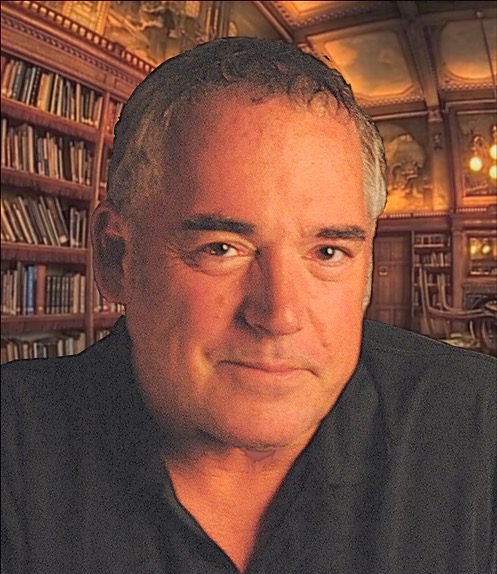
Gary McAvoy is an American novelist known for internationally bestselling thrillers that blend historical intrigue, religious scholarship, and modern suspense. A lifelong researcher of rare manuscripts and Church history, he draws on extensive archival study to craft narratives rooted in authentic detail. His work includes the Vatican Secret Archive Thrillers, the Magdalene Chronicles, and the Vatican Archaeology Thrillers. Before turning to fiction, McAvoy built a distinguished career as an entrepreneur, technology consultant, and collector of historical documents. He now writes full time from the Pacific Northwest, where he continues to explore the shadowed crossroads of faith, power, and history.
Catch Up With Gary McAvoy:
GaryMcAvoy.com
Amazon Author Profile
Goodreads - @garymcavoy
BookBub - @garymcavoy
Instagram - @gary_mcavoy
X - @GaryMcAvoy
Facebook - @GaryMcAvoyAuthor
Review:
A centuries-old art theft and forgery operation is uncovered at the Vatican.
The Vivaldi Cipher is the first book in author Gary McAvoy’s riveting new series, the Vatican Secret Archive Thrillers, and reunites two sleuthing partners from his earlier Magdalene Chronicles, Father Michael Dominic and Hana Sinclair. While on a working holiday in Venice with his good friend, investigative reporter Hana Sinclair, Jesuit priest Father Michael Dominic is consulted by his old seminary friend on a tricky matter regarding the sanctity of the confessional and the devastating information he received during a dying man’s last confession.
Father Carlo Rinaldi had been called to the bedside of the capo of the Veneta Camorra (Venetian Mafia), whose regular confessor was unavailable. With fear in his eyes, he revealed the details of a centuries-old art theft and forgery operation that had been swapping valuable works from the Vatican Museum’s collection for forgeries right under the nose of the Holy See. His last request is that his young confessor put an end to it all. But if the man’s story is true, and how could it not, how could this have been going on undiscovered for so long… without insider help? The answers may come from an unexpected source, hidden within the musical works of the famed Venetian composer and priest, Antonio Vivaldi himself. But as Michael, Hana, and their friends begin to ask questions, they soon discover someone will do anything to keep this operation a secret, including committing murder.
Father Michael and Hana are both such engaging characters, long-time friends who’ve been through a lot together, and it was interesting watching them navigate their “strictly friends” relationship amid the suspense and danger that ensued. A warning: the author is not afraid to sacrifice high-profile characters for his story, and that really ups the stakes in an already high-stakes affair.
The plot escalates quickly, and the action keeps going nonstop. The author’s vivid descriptions of the iconic settings around Venice and during Carnival really brought the mental images I constructed to life (while also providing important tips for those considering a visit to the ancient city). As the reader knows from the start what the crime is, who at the Vatican is actually involved in this old, established scam becomes the important question.
Although this book continues a partnership from an earlier trilogy, it works well as a standalone, and readers new to the characters should be able to read and enjoy this new adventure without having to hunt down the previous books first. However, it sure did make me want to when I was done!
I recommend THE VIVALDI CIPHER to readers of mysteries and thrillers,
especially those who enjoy stories involving the clergy or the Catholic Church.
Tour Participants:
Click through the other tour stops for can’t-miss reviews, insider interviews, exclusive guest posts, and more chances to win!Click here to view the Tour Schedule
A Fine-Tuned Mystery & More to Win:
This giveaway is hosted by Partners in Crime Tours for Gary McAvoy. See the widget for entry terms and conditions. Void where prohibited.
THE VIVALDI CIPHER by Gary McAvoy | Gift CardsCan't see the giveaway? Click Here!


